
Normally food memories come with nostalgia of taste, fragrance of seasoning, food associated with festivals and seasons and almost always with the one who prepared the food: a mother or a grandmother. “This food does not taste like what my mother makes” is the general complaint of most husbands in real life and fiction. In Tamil families it is usually referred to as “kai manam” or “fragrance of the hand”, which not everyone is gifted with. It is a gift of nature. My food memories are not only associated with all this but also with how my mother Alamelu, lovingly called Alamu by everyone, dealt with food as a concept. Food was not just cooking tasty sambars made with small onions on special occasions and otherwise with drumsticks, pumpkin, radish, colocasia or just with lentil dumplings with a paste of coconut ground with spices added to it seasoned with mustard, fenugreek and red chilies in oil (always in sesame oil for sambars) or some twelve different rasams, not to talk of bisi bele baath and kosambaris, as we lived in Bengaluru. What made food happen was important for her.
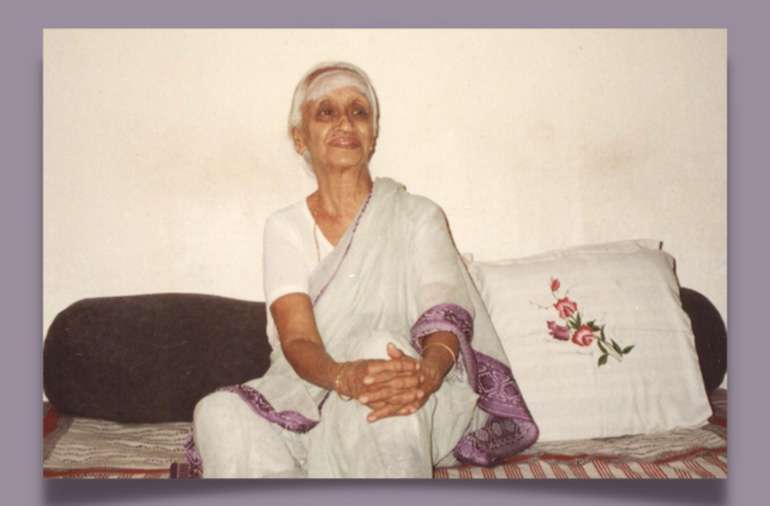
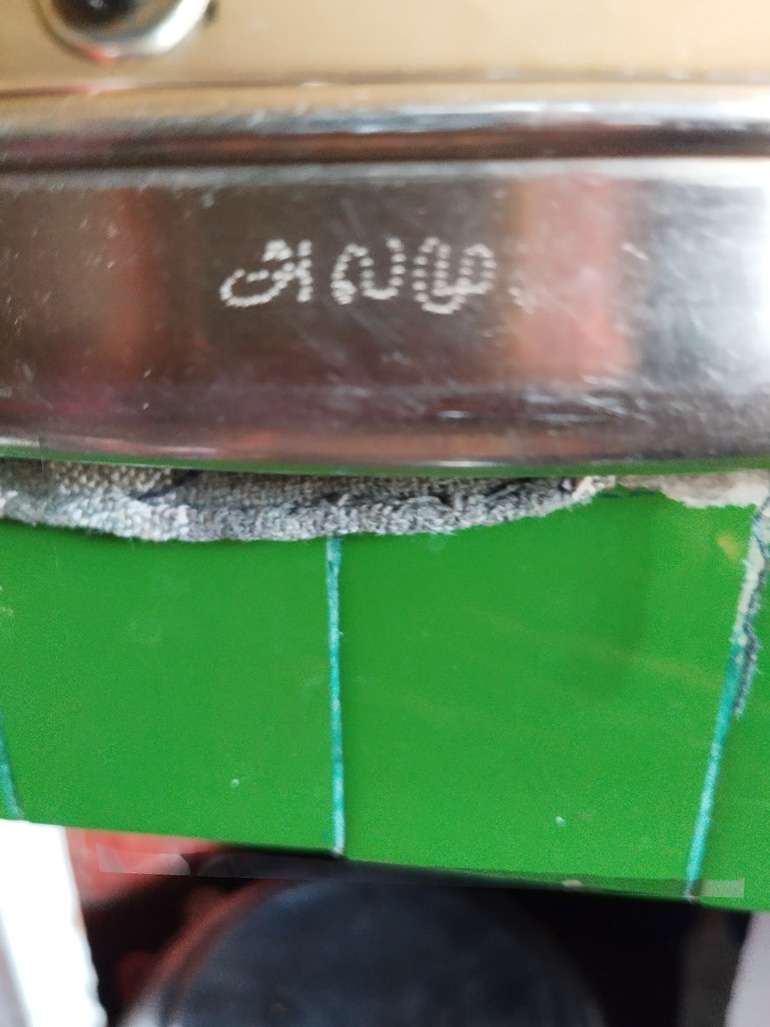
My mother got married in 1926 at the age of 11. When she came to her in-laws’ home she was about fifteen. She came with many things for the house given by her parents including vessels on which her short name “Alamu” was etched. In a big family it is good for the different daughters-in-laws to have vessels with their names etched on them to avoid future quarrels. All the vessels in our house had my mother’s name etched on them. My mother learnt all her cooking from her mother-in-law who was widowed when my father was about 14 years old. As per customs of those days, she was tonsured and given a dull brown colour nine-yards sari to wear. But she had a family to bring up. Her two elder sons were trying to settle down as engineer and lawyer and two daughters were already married. But she had three sons still studying including my father. Since there were cows in the house, she started a milk business to run the family. It is from this enterprising woman that my mother learnt to cook. So, along with cooking came knowledge of what kind of firewood to buy, making one’s own coal stove and roasting and blending of coffee beans and powdering it fresh every night for the morning filter coffee.
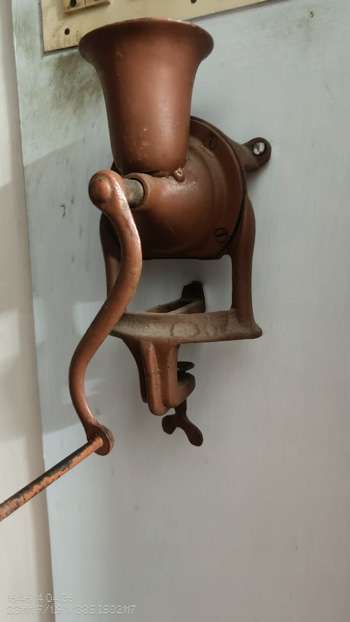
My mother made her own coal stove in cement casting using a tin bucket. She used to get a small tin bucket and fill it up with cement and make a curved cut in front for lighting the stove. Once the cement dried, she lifted the bucket off. “Amma, how do you decide what size the front curved hole must be?” my elder sister asked her once. “The hole in front must allow your arm to enter. That is the size,” my mother told her. And we had a coffee grinder fixed on the shelf in the store room. Every night, it was the duty of one of us to turn the handle and powder the coffee beans carefully fried by Mother and kept in a tin. The powder would fall in a holder, placed below the grinder, called “dabara”, which looked as brown as the coffee powder. When we heard the sound of her hitting the top portion of the coffee filter with the iron tongs, for the decoction to fall, we knew it was time to get up.
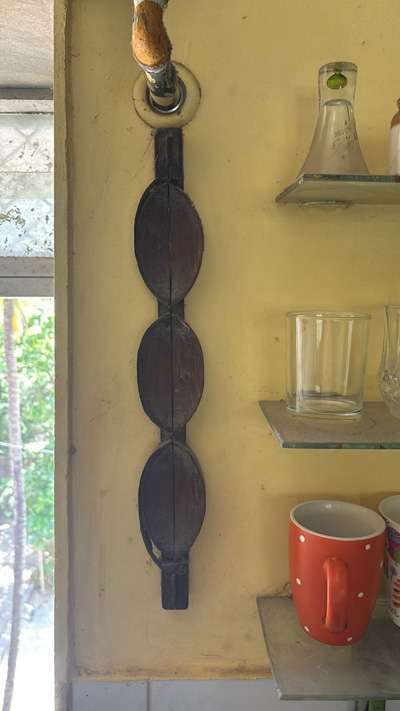
We had a copper pot to store drinking water. It was scrubbed clean with coconut fibre and finely powdered brick and was always glowing bright. On its mouth was etched my mother’s name “Alamu”. Then there was the foldable kozhukkattai or modak maker made in wood. After making the dough for the kozhukkattai with rice floor put into boiling water with a little oil and stirred with a wooden spoon (often the end of the wooden churner used to churn curds to make butter) till it thickens and then made into big balls and steamed, and preparing all the fillings—coconut cooked with jaggery, lentil crumble, made with urad dal soaked and ground with green chillies and ginger and later steamed and crumbled with hands and sesame seeds and jaggery powder—would start the kozhukkattai preparation. In a wooden presser with a fixed aluminium plate with a horizontal slit at the bottom, the steamed rice balls would be placed and gently pressed with the handle of the presser to spread like a narrow sheet on the kozhukkattai mould. The filling would be placed and then the mould folded. Extra dough hanging at the bottom would be removed and the mould would be opened and lo and behold there would be three kozhukkattais inside! With two moulds, a set of six kozhukkattais would be made at a time and steamed in the idli vessel. With three different fillings at least some hundred kozhukkattais would be made, for the Ganapati idol only saw the kozhukkattais placed before him as prasad, but there were the four of us children to gobble them up all!
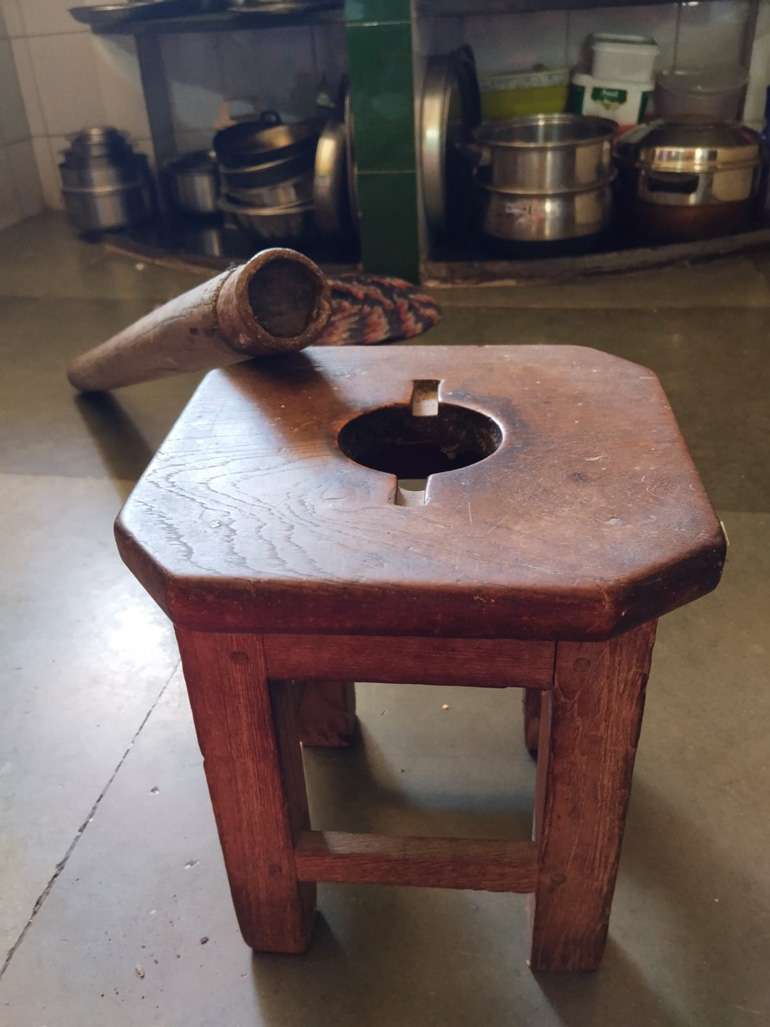
Then there was the little wooden stool with a hole in the centre to hold the brass mould with small holes in which we made rice noodles called sevai. Steamed rice balls made the same way as made for kozhukkattai were placed inside the brass mould and pressed hard with a wooden presser. When pressed, steamed rice balls fell as noodles into the vessel placed below, steaming hot. It was difficult to press the presser sometimes and my mother always asked my father to press it placing horizontally a wooden pounder with an iron ring at one end used for pounding rice, and he would do so, holding both ends of the pounder and pressing it. The rice noodle was then made into different flavoured noodles, a tamarind one, a lemon one and a coconut one and seasoned with mustard, urad and chana dal and curry leaves, and with roasted cashew nuts placed on top of each flavoured dish.
There was also the silver bowl which all of us ate from as children. As we grew up, it was brought out whenever we were a little sick. Hot rice was placed in it and mashed with home-made ghee and hot cumin seed and pepper rasam poured on it and mixed and the bowl would be brought to the sick child, with a roasted pappad to go with the rasam rice. A fussy child would be fed by Mother with her hand and put to sleep with a song sung in Nilambari ragam.
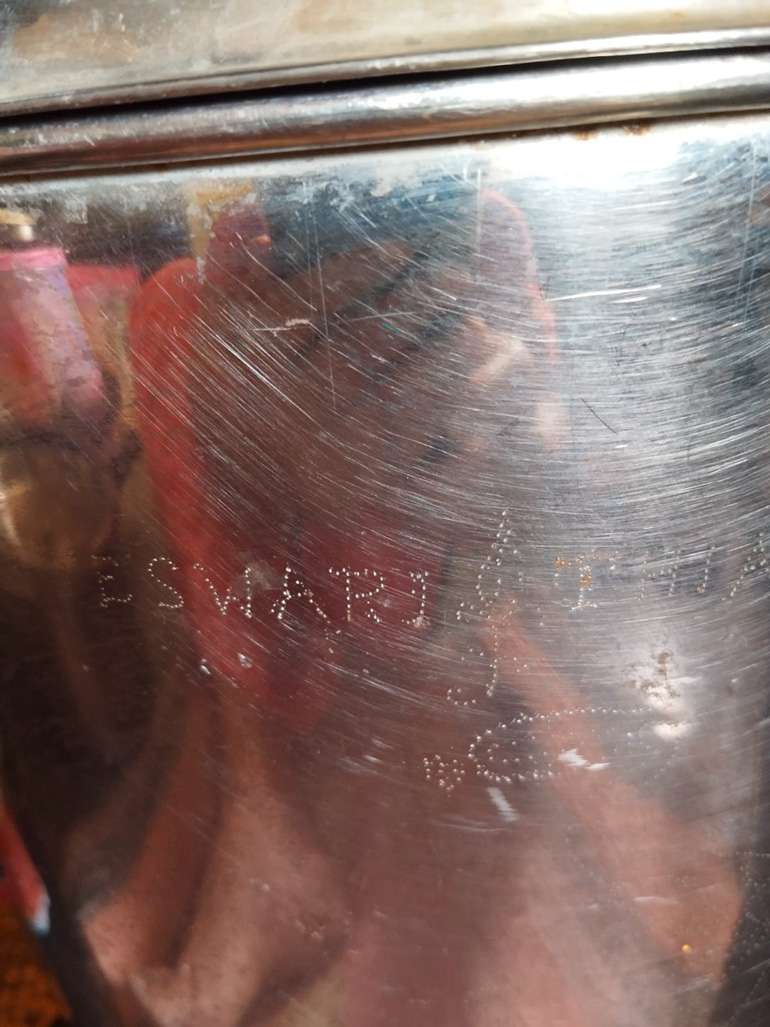
I began writing this with vessels etched with names. In Bengaluru those days, often in the afternoons, we could hear the shout in Tamil from the street in the afternoons saying, “Steel paathram paer podaradhu…” (Names etched on steel vessels). These were artisans from the Tamil speaking areas. They etched the names mentioned on the vessels and plates and often decorated them with images of peacocks and other birds and flowers. Almost all the plates and vessels I have of my mother’s have her name, which was etched in the twenties. Names on new vessels she bought were etched by these wandering artisans who did not have enough work. The electric ones we have now in vessel shops are nothing compared to these artistically done ones. I have a drum with my sister’s name Rajeswari on it with a little bird at the bottom of the name. It is beginning to fade though.
I cook exactly the same way according to the recipes given by my mother. But it does not taste the same because I don’t have a household like hers nor the “fragrance of the hand” that she has. When my father fell sick the Bengaluru house was vacated. Mother brought almost all her vessels, except the big brass drums, ignoring her Mumbai children who grumbled their houses cannot hold all of them. She even brought the iron frying pans which she remembered by the years they were bought and their prices. The heavy iron one I have with me now was bought for eight annas when my sister was a little girl. The very small brass one used for seasoning sometimes was bought much later in Bengaluru for a rupee or so. Once when I visited my brother’s house my mother said no one wanted to use the copper pot or the rice noodle maker wooden stool or the iron deep frying griddle in which we make sweet and savoury dumplings called appam, and if I would like to keep them in my house as she did not have the heart to throw them away. The wooden stool also used to double up as the stool we sat on when my sister and I had oil bath with our mother oiling and massaging and scrubbing our hair every Friday without fail. I told her I would keep them in my house. She brought out the copper pot and the stool and the wooden presser. Along with it she also brought the wooden pounder with an iron ring. I brought them all home. As I walked in, Vishnu, my husband, asked, what the pounder was for. “For self-defence”, I retorted! There it is behind the door wrapped in a newspaper ready to be used if ever a thief dares to enter our house or if anyone dares to assault me! I tried to make kozhukkattai once but it was a disaster. The rice dough did not fall like a nice sheet smoothly on the mould. I had to then make it with my hands. The mould is there though like a wall decoration. The wooden stool is also there and once a foreigner hesitantly asked if it was a traditional toilet seat used for children! The copper pot is kept near my window facing the east and with the salty air from the sea it is not as bright and gleaming like it was in our Bengaluru home. But it is there and often I stand running my finger on the name “Alamu” etched on its mouth. It is almost faded now but the “அ” of “Alamu” can still be felt. It reminds me of my mother and a household she filled with food and love.

What a beautiful bundle of narration filled with wholesome memories,the eternal love for one’s mother ,her and our world with her ,the small ironies of life -the etched vessels of yore finding a home only in a daughter’s household -all this ,and something more -the smell of warm rice mixed with ghee fills one’s senses.
Thank you CS Lakshmi for such a lovely read!
Reading the article made me think of those days when a person would be employed in a stainless steel vessel shop solely to engrave the customer’s name or initials on the vessels. Today, it is done using an electric engraving machine, but when I was a child, it was done manually with a sharp stylus-like nib and a supporting stone. It was truly a skilled craft. During marriages, it is customary to engrave the bride’s name on both silver and stainless steel vessels. Even those who gift us vessels often have their names engraved on them. It is a simple tradition, but one that carries memories, identity, and a personal touch.