
![The Food Culture of Bengali Muslims <br>Volume 6 | Issue 1 [May 2026]](https://www.oneating.in/wp-content/uploads/2026/07/Cover-img.jpg.pagespeed.ce.OLwuKb2e3g.jpg)
Translated by V. Ramaswamy
Art – Samim Akter Sheikh
As I was reflecting on the food culture of the Bengali, it struck me that the label bheto Bangali – meaning a rice-eating Bengali, a somewhat derogatory epithet for someone of an idle disposition – is in fact a thoroughly foolish notion. I do not know to what extent Bengalis have been able to share their culinary delights with the world; however, through the ages, they have certainly adopted a great deal from various corners of the globe. Whether the Bengali is Hindu or a Muslim, they no longer sit by idly, content merely to be a rice-eater. Their love of momo, pizza and biryani may well enable adjectives like memo, pizzu or biraniya, among many others, that can be bestowed as appellations upon the Bengali today!
If I were to speak about Bengali Muslims, I can recall a rural adage; it is said that a Hindu’s house and a Muslim’s cooking pot – both sparkle.
Whether the Bengali-speaking Muslim – a son of the soil of West Bengal – is at all accepted as a “Bengali” or not – there is an entire pointless debate around that. And so, whether one can even dare to regard the culinary culture of Muslims as an integral part of Bengali culinary culture – that too remains a subject of profound scepticism among learned circles!
Among the distinctive characteristics and signs of refinement of a Muslim household pot are that it must be large in size and, in terms of material, be made of copper. It is said that unless there is a clanging and banging sound while cooking, the food lacks joy. Of course, this applies only to festivals and ceremonial feats. Instead of focussing on a grand festival, let me share a few thoughts regarding the Iftar (fast-breaking meal) of just one day during the month-long observance of Ramzan.
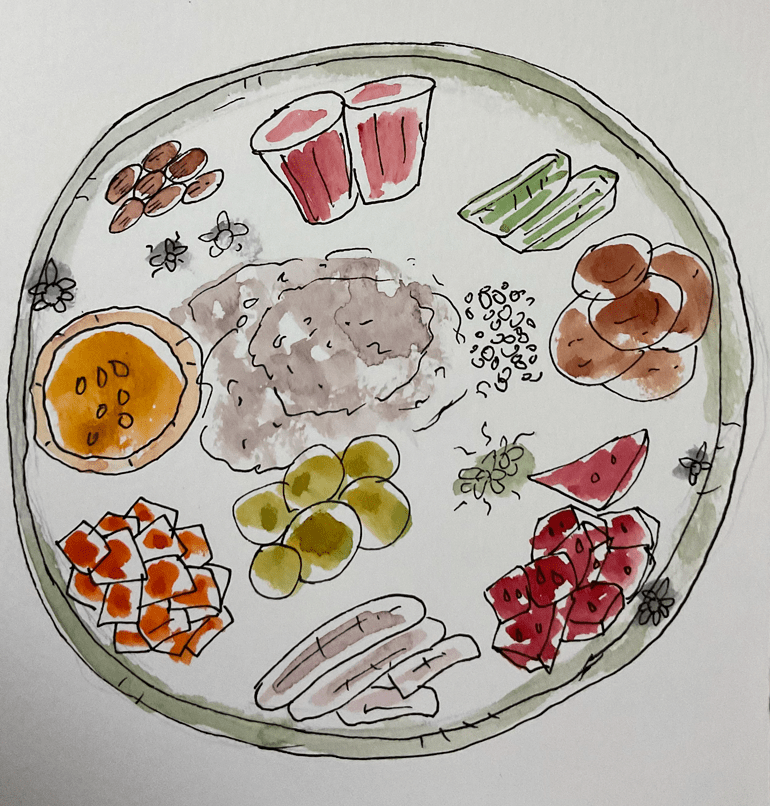
I had invited my dear friend, Dr. B. Chowdhury, to my house for Iftar that day. I sat down at the Iftar spread with the guest who arrived at Magrib (the evening prayer time). Various dishes were laid out in front of us. Looking into his curious eyes, I asked him, ‘What is on your mind, Sir?’ He said, ‘I am thinking about the dire consequences of stuffing oneself with so many different dishes all at once during Iftar. Will the body be able to withstand these after a waterless fast from dawn?’ I smiled. He was a doctor; so, it was only natural for such thoughts to cross his mind. Indeed. But dates were right at hand on one of the plates placed on the tablecloth. This fruit has become sacred to Bengali Muslims, solely out of love for the Prophet Muhammad. Why so? Because he used to eat and love the date fruit, a national treasure of the desert country of Arabia dating back to time immemorial. Breaking the fast in rural Bengal with jujubes or bananas would surely not have destroyed one’s faith! However, eating dates has indeed become a distinct tradition of the Muslim community. It is a very important part of the teachings, practices and traditions of the beloved Prophet. Iftar is thus auspiciously commenced with dates.
The cool liquid in a glass that is picked up while the date is still in one’s mouth – that is sharbat. The word sharbat is of Persian origin. However, it is derived from the Arabic word sharab, which means “to drink”. The Persian word apparently became the Turkish word sarbet and entered the Bengali lexicon as sharbat. This beverage is not merely for Iftar; when guests arrive at home, serving sharbat is the very first step of hospitality. A colourful sharbat is served in a glass. Tea and snacks come only after that.
Bengali Muslims are fond of giving Arabic and Persian names to their children. There is a story about this. A girl was given the name “Sharbat”, and their surname was “Khan”. So, her name became Sharbat Khan. A prospective groom’s family had come to see the young woman. As she handed a glass of sharbat to the elderly gentleman, he asked her, ‘What is your name, child?’ She replied, ‘Sharbat Khan’. The gentleman said, ‘I’ll certainly have it, but tell me your name.’ Once again, the young woman said, ‘Sharbat Khan.’ How awkward! The elderly gentleman gulped down the sharbat, and then asked again, ‘Okay, so tell me your name now, child?’ The young woman again said, ‘Sharbat Khan.’ Meanwhile, the glass was empty. So, what could he eat? (Sharbat Khan also means, have the sharbat, or drink the sharbat! Actually, the verb for consumption in Bengali, whether of food, drink, or even a cigarette, is khaowa, or to eat. They don’t drink!)
So how did Bengali Muslims acquire this immense love for sharbat? According to Islamic scriptures, when a believer enters Paradise, they will be served a drink called sharaban tahura. Something sweeter than honey, and whiter than milk. The very sensation of thirst vanishes in the afterlife after drinking this. Sharbat became popular in Bengal during the period of the Muslim rulers. Infused with sweet attar (perfume), the sharbat called Rooh Afza possesses a heavenly fragrance.
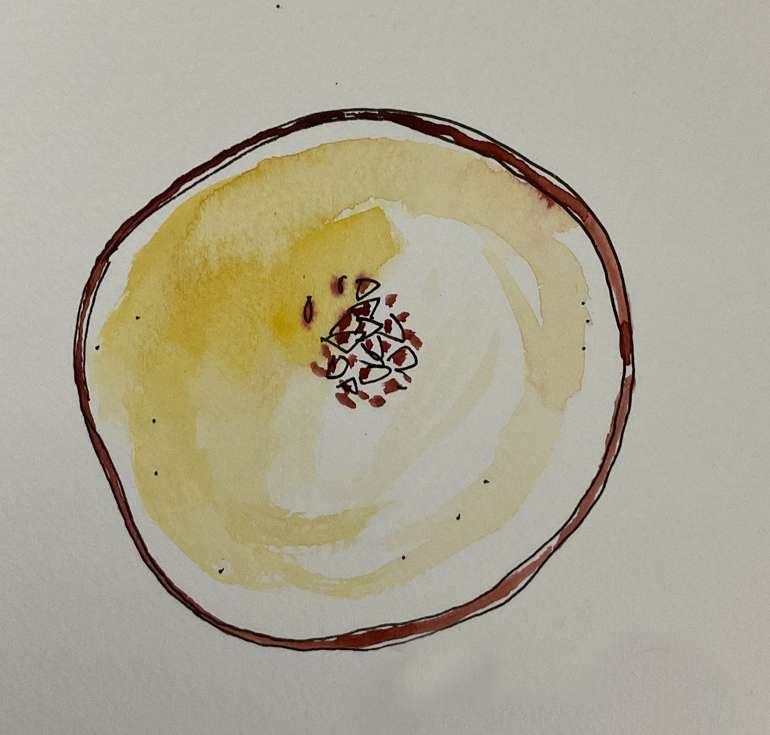
Coming back to my anecdote, having partaken of the sharbat chapter, the doctor observed that many of those present were eating different kinds of fruits. And some people were eating something from small earthen bowls, using tiny spoons. This was called firni. The word firni too is of Persian origin. Firni is a delicious, thick, traditional pudding-like dessert made from ground rice, milk, sugar, and aromatic spices. In order to prepare this, a paste of soaked basmati or gobindobhog rice is mixed with milk and cooked until it thickens.
After partaking of the variety of fruits, both local and exotic, next in the Iftar spread is the Bengali’s most cherished and delectable treat: the crispy, indigenous muri (puffed rice). But the muri never comes alone. It must certainly be accompanied by telebhaja. This batter-fried delicacy is made with slices of eggplant, potato, onion, or mashed potato, or a boiled egg. I do not know how long the association between Iftar and telebhaja is. But in various countries, such deep-fried items have long been cherished as an important part of the Iftar meal for those observing the fast. Be it in the Western world, the oil-rich Middle East, or in this very subcontinent – telebhaja is an absolute must.
A telebhaja shop is to be found in every street corner in Bengal. Perhaps it was this that prompted the former Chief Minister of this state to lay emphasis on the telebhaja industry. But how could she possibly convey the immense significance that the telebhaja truly possesses? And why only her? The Prime Minister himself had once urged the nation’s youth to set up pakora, i.e. telebhaja, shops. But he travels the entire world on the people’s hard-earned money so that he can recover black money. So, he may well have forgotten about that altogether, but he has now realised that there is no way forward without oil. The nation wants oil. Do you want to rise to a very high position by selling tea? You need oil. Do you, despite being of an ascetic and mendicant disposition, want to become Chief Minister? You have to apply oil. It is also required when you hop into another party.
Didi’s rule has come to an end. She might perhaps garner a share of the notoriety for “appeasing Muslims” from the telebhaja as well. Because she had prescribed selling telebhaja as one of the ways of eradicating unemployment; but meanwhile there were a vast number of telebhaja customers who belonged to the minority community. After all, there is always a demand for telebhaja during the month of Ramzan.
Let us return to the Iftar gathering. Among the array of tempting delicacies, the different varieties of telebhajas shone brightly in their own glory. One of them was called “the bomb”! Dr. Chowdhury’s friend, Shankar-da, was perhaps left a bit dumbfounded after hearing the name. But this was not the bomb employed during the Panchayat elections. This bomb had emerged in competition with the telebhaja varieties like alur-chop, aluri, piyanji and beguni. It was somewhat larger than the extremely loud firecracker called a “chocolate bomb” that was sold under the “Burima” (or Granny) brand. But instead of gunpowder, it had minced beef inside; and so, like gunpowder is called barud, perhaps this could well be called gorud (cow-powder?)! Something even more destructive than gunpowder! Because gunpowder affects only the body, whereas cow-powder influences the politics of an entire country.
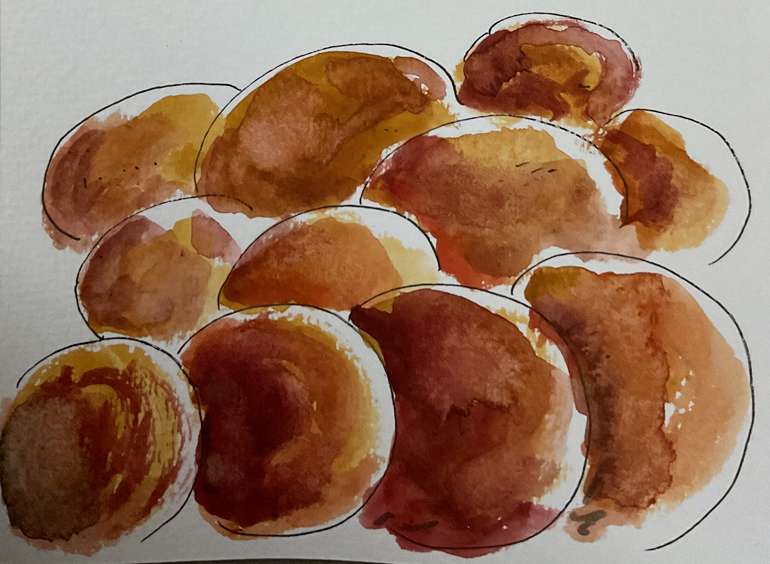
This bomb was exceptionally tasty. Maruf, the friend sitting beside me, asked me with a smile, “This innocuous bomb you see here – how harmful do you think it is for the country?” I said, “What are you talking about, my friend? All the thinking, in fact the entire consciousness of the country, revolves around this very meat. It is because the beef-bomb is exploding that the image of the community as well as that of the nation is changing, my friend. Look at all these bearded, skullcap-wearing Muslims breaking their fast together – all of them busily and contentedly feasting on bombs. Can you see that? Now just imagine an Islamophobic journalist were to show up here – what would he go back and write in his newspaper?’ Doctor Babu laughed, and asked, ‘What will he write?’ I said, ‘He has to write, “Muslims don’t just make bombs, they eat them and digest them, too.” The reporter apparently witnessed with his own eyes the scene of a hundred or so people devouring bombs from their plates. He wrote, “The “bomb-eaters” (Muslims) were engrossed in a discussion about its taste. Some say that it would have been better had it been a bit spicier. Some were expressing the opinion that there was too little salt.” Finally, in conclusion, he might perhaps write – “Dear readers, consider this: is this spiciness truly the heat of chillies? Or it is perhaps a symbolic atomic-sting – you yourselves may surmise that. Let me remind you, everyone’s attire here is, in fact, the madrasa uniform. A white punjabi, and a skull cap! Isn’t that, too, a cause for a headache? These bomb-digesting terrorists could prove extremely dangerous for the country! The Home Ministry should look into this.”
Many people laughed. Maruf continued, ‘Reading this could cost a certain class of progressive patriots their night’s sleep. Some leaders might raise the matter in Parliament. Some intellectuals might run around the streets holding candles! Their demand – all madrasas in the country should be shut down.’
Halim is one of the most important dishes for Iftar. It is a very popular item of the Bengali Muslim community. Many people want to call it dalim – which literally means pomegranate, but is meant to refer to the dals, or lentils, with which it is prepared; but also, more fundamentally, Al-Halim, or The Forbearing, is one of the names of Allah, and Muslims do not give anyone or anything the name of Allah. Thus, a person would be named Abdul Halim, meaning a slave of Allah, the Forbearing One. Wheat, rice flour and at least ten or twelve varieties of lentils, right from masur, to teoyra and mung, to motor and kolai must be soaked for about seven hours. That is then cooked with pieces of boiled meat. This is cooked for about ten hours with a variety of spices. It must be continuously stirred until it becomes a completely viscous, sticky liquid. Finely chopped onions are then roasted and sprinkled over it. Upon beholding this extraordinarily delicious and highly nutritious food, my Doctor friend shook his head. He said, “All the deficiencies resulting from a fast without water are made up right here.”
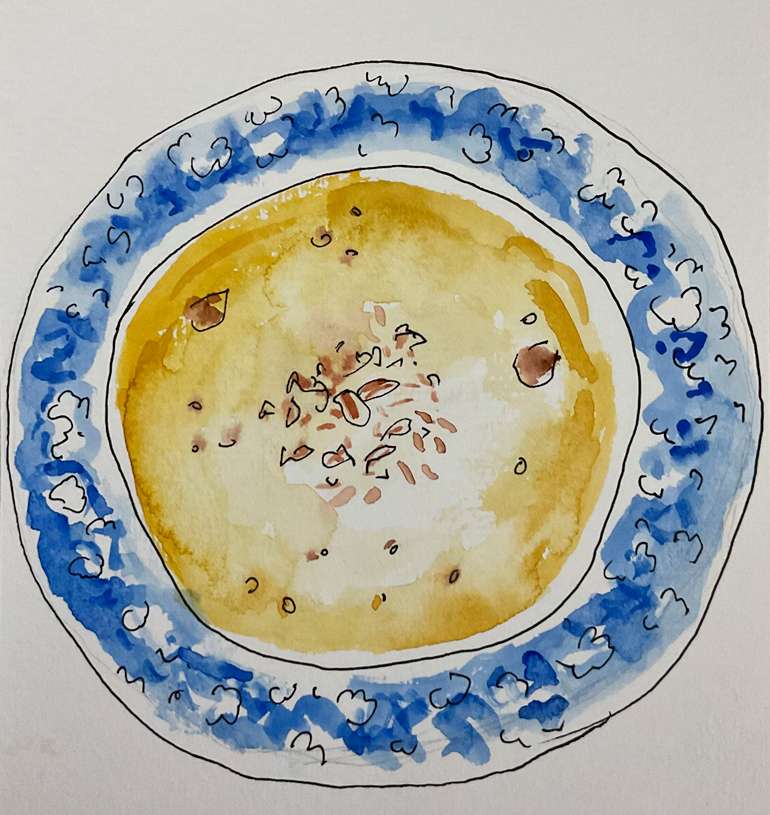
It is, of course, unclear to what extent the deficit is made up. Because the sighting of the new moon happens only after an entire month of fasting. The following day is Eid. Special dishes for Eid are prepared on the night of the new moon. A traditional item in a Bengali Muslim household is a white ruti made from rice flour. This ruti is so thin, smooth and stainless that when one touches it, it feels like fine Dhakai muslin fabric from ancient times. Rice powder is soaked and then sun-dried before turning it into a fine flour. A dough is first prepared by heating water in a large pot and pouring in the dried flour. This must be done very carefully. If the dough is not correct, the rutis won’t be nice. The dough is then cut into discs and rolled out by hand. It is finally toasted over low heat. This ruti is eaten with simui, or simai (vermicelli). And thus, we arrive at the subject of vermicelli. Simai is apparently the only guest to have arrived from outside the Muslim world. According to the linguist, Suniti Kumar Chatterji, the word semai originated from the Greek word semidalis. That means corn flour. The word is said to have entered Bengali through Greek-Indian contact, dating back to the time of Alexander’s invasion of India. The interesting thing is that there was no territory then by the name of Bengal. But whether semai originates from Greek or Turkish is of little consequence; what matters is that it has found its way into the cooking pots of Bengali Muslims. And it arrives on the joyous day of Eid itself. And so, the Islamisation of vermicelli took place a long time ago. Having thus lost its caste, it finds no place in a Hindu household. Even till a few decades back, grandmothers used to make vermicelli strands with their own hands. Machines subsequently arrived; one prepared the threads by turning the machine by hand. It is now manufactured and marketed by multinational companies. Vermicelli is primarily of two types. Of a fine variety, and a coarse variety. The fine simai wallows and bobs about in milk, whereas the coarse variety remains on dry ground – eaten completely dry. Vermicelli is a cherished and exclusive guest in a Muslim household. And it pairs perfectly with rice-flour rutis.
 I tried to provide a brief glimpse into the culinary culture of the Bengali Muslims of West Bengal, in India. One would observe further culinary diversity across different regions. Had laws not been imposed on food, this wealth of diversity would have been even more extensive.

Lovely!
What a beautiful read in Bengali. translation in English is equally engaging.