
It all started in the year 2023, when the world was still recovering from the pandemic. My way of starting life again was moving to Mumbai, on a decision that was taken almost overnight, because that city seemed to be where women were safer and where people were being paid to be theatre artists. Barely, but that didn’t matter because I was on my way to change that. Optimism was still left in me.
I got a job as a theatre facilitator in a well-known company that sent employees to different schools to teach theatre. I was uncomfortable with it because most of the facilitators were untrained. I was probably the only trained theatre artist there, and yet the company was capitalising on theatre without really practising theatre. But I needed that job. I had only ₹11,000 in my account. I had finished my Master’s in Physics more than a year earlier and had lost touch with academia enough that going back by writing the NET or SET no longer felt like a real option.
By daybreak, I stepped into my role as a theatre teacher, trying very hard to believe that I was bringing the transformative power of theatre to young minds. My hours stretched from 8 a.m. to 4 p.m., Monday through Saturday, for which I was paid ₹18,000 a month, provided I hadn’t taken a holiday.
Then came the arithmetic of survival. ₹11,500 vanished into rent. ₹2,500 went to Rentomojo. I had rented a fancy desk and chair to remind myself that I was a writer. These were the only pieces of furniture in my room in a flat in Aarey Forest that I shared with my flatmate. ₹453 went towards a bag of Third Wave Coffee’s Vienna Roast after the members’ discount. Good coffee had always been a priority. There were days when I could wake up motivated only because I knew there was good coffee waiting in the kitchen.
That left me with ₹3,547 to navigate the month. It had to cover auto fares, bus fares, metro fares, sanitary napkins, sunscreen, play tickets because one had to watch plays regularly; that was the only study and, of course… food.
But one had moved to the concrete jungle to pursue theatre, and that had to be done. So, I searched for opportunities in a play. It was far, far away from the kind of theatre I believed in or the politics I had subscribed to. The rehearsal room became increasingly unprofessional with every passing day, but I stayed because, at the end of it, I had my only real meal of the day. Some rice, some sabzi, some dal, with real people around me to eat with and talk to.
It was only much later that I understood that the food was a currency.
A year after moving to Mumbai, I was making my first play, The Apology. I was still getting used to how theatre functioned in the city, so I trusted the producer I had appointed. During one conversation, I suggested that we should give the actors a travel allowance along with their performance fee, which was already very little because of the size of the grant I had received. The producer suggested something else instead.
“Let’s give them food.”
The idea was new to me, so I agreed.
A few weeks into rehearsals, the food gradually became inedible. That bothered me more than I expected. I was already uneasy that we were using food to compensate for what should have been money. Theatre has a way of romanticising sacrifice, and I did not want to romanticise this one. My actors deserved to be paid well. I simply did not have the money to do that. What I could do was cook. So, after four-hour long rehearsals, I went into the kitchen. Slowly, everyone joined in. One of the actors, who lived with their family in Mumbai, would bring food from home. Someone chopped vegetables, someone stirred the dal, someone washed the dishes. We ate together before heading home. I knew that a shared meal could never replace fair pay, but hoping it could at least make the long rehearsals a little kinder.
I have often heard journalists ask film actors what they eat in a day. I would sometimes imagine myself on one of those talk shows, finally successful enough to be asked the same question. My answer would be, “Vada pav, vada pav, and coffee.”
And then my phone would ring.
On the other side would be my maa asking, “Kheyechish?” (Have you eaten?)
“Hyan maa, mangsho aar bhaat kheyechi.” (Yes, Maa. I had meat and rice.)
Let us go back a year, to the time when I was doing a horrible play only because it came with dinner, and with people to eat that dinner with. It was the only meal of the day that I did not eat alone.
Then one day the rehearsal got cancelled.
Which meant there was no free dinner.
I remember having less than ₹200 in my account. On days like these, I usually slept early so that I would not have to feel hungry. But that evening, after many days, I finally had the opportunity to sit at my fancy study desk. I cooked some Maggi. Nestlé was the only thing I could afford. As I ate, I opened my laptop to read Bertolt Brecht. Not because I am that hardcore of a Bengali, but because it was his 125th birth anniversary and I thought I should brush up on Brecht.
Instead, I stumbled upon hunger.
I found a treasure trove of his writings on food and eating. In Refugee Conversations, Ziffel casually remarks, “Humanism goes beautifully with a good beef consommé.” Then I came across the poem The Shopper.
If all of us who have nothing
No longer turn up where food is laid out
They may think we don’t need anything
But if we come and are unable to buy
They’ll know how it is.
I was bawling.
The poem made me think about every story of hunger I had inherited. Stories of the Bengal famine, of people going from door to door asking for phaena, the starchy water drained from boiled rice. Stories of how poppy seeds found their way into Bengali cuisine because there was little else to eat. Stories of my family migrating from Bangladesh during Partition. Stories of my parents borrowing money to buy me milk after the IT company where Baba worked shut down.
Compared to them, my hunger felt almost bogus.
Their migration had not been a choice. Their hunger had not been a choice. Mine was.
But was my hunger any less real?
Right then, my phone rang.
“Maa.”
“Kheyechish?”
I remember looking at the half-eaten bowl of Maggi and thinking I would do anything for some phaena bhaat and posto.
Instead, I lied.
“Hyan Maa, kheyechi. I’m just busy.”
A few minutes later, she transferred ₹1,000 into my account. Maybe the mother in her recognised the hunger in my voice. Or maybe it was the caterer. By then she had started a Bengali catering business after Baba retired. She fed people for a living.
I did not spend the money immediately. I saved it for the next rehearsal that would get cancelled.
“Is my hunger even valid?”
I could not stop thinking about that question.
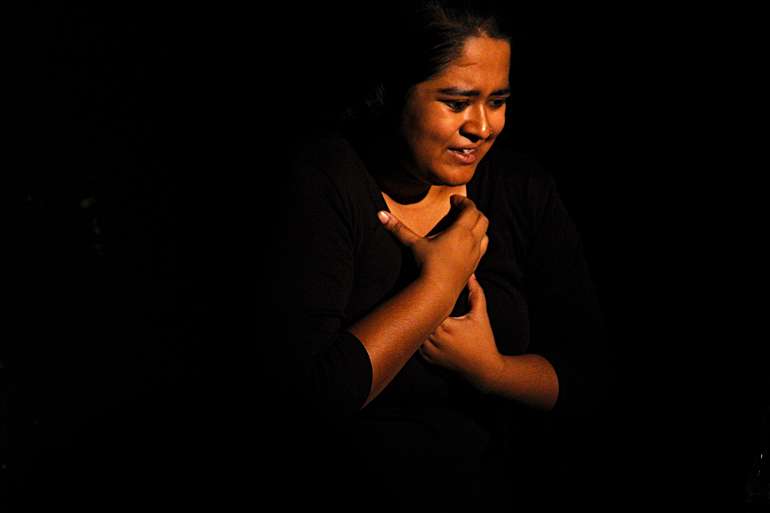
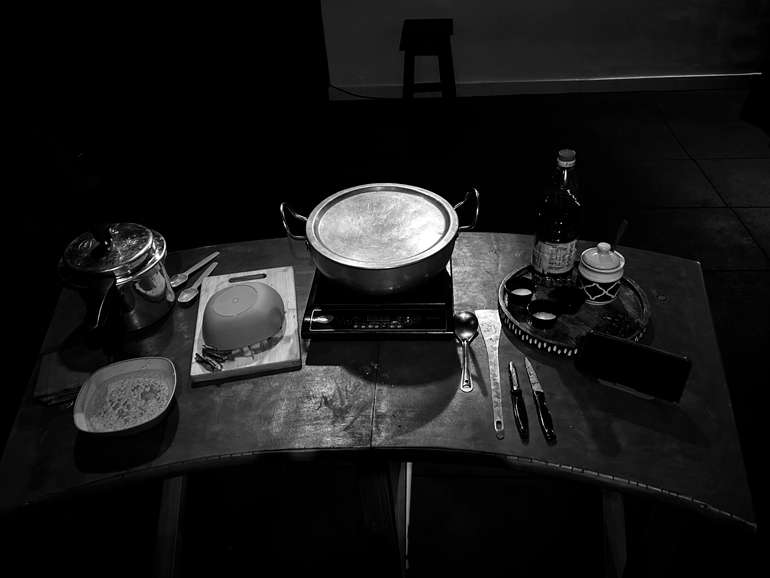
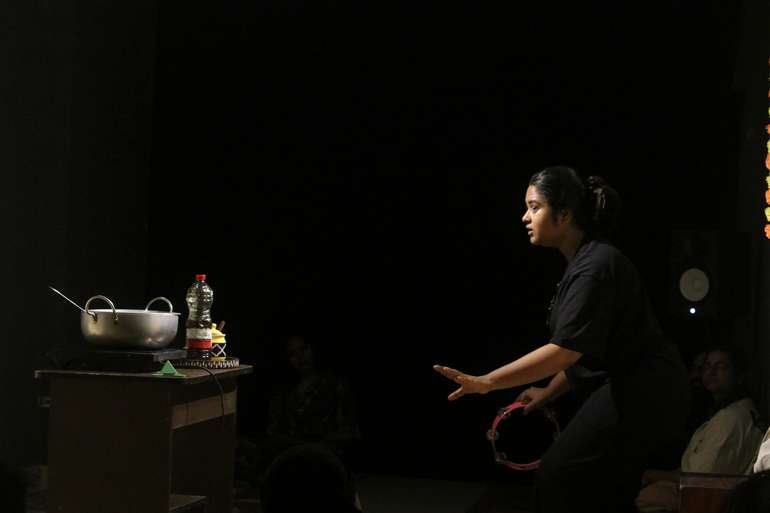
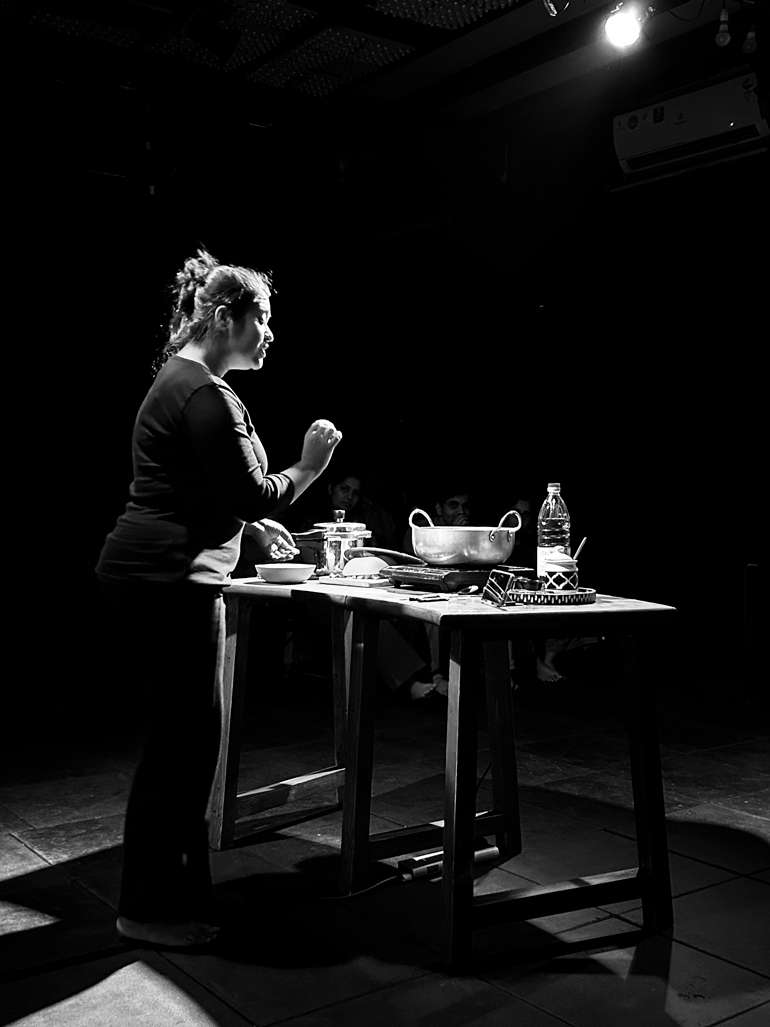
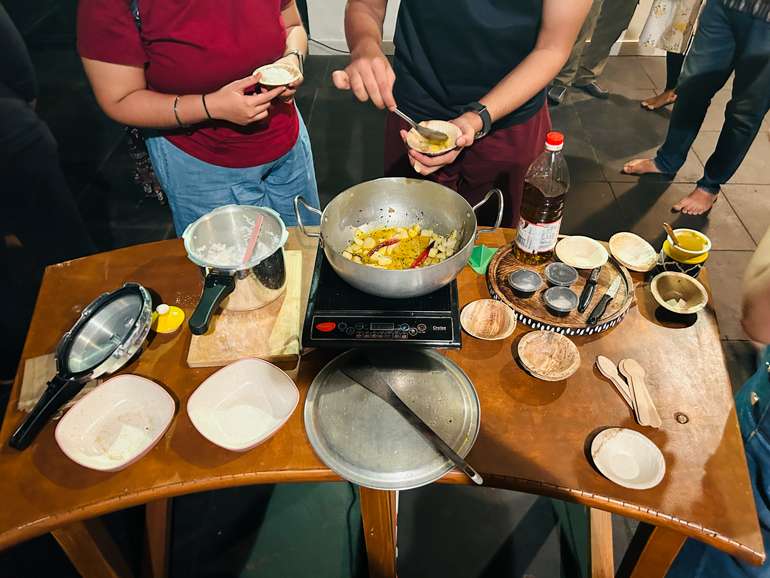
Kheyechish? is a ninety-minute theatre performance with live cooking, but it did not begin as a play. It began with that question.
I started talking to my colleagues about chosen hunger. We spoke about the meals we skipped to pay rent, the lies we told our parents over the phone, the food that travelled across cities in steel dabbas, the dinners that came with rehearsals, and the ones that disappeared when rehearsals were cancelled. I learnt how, in some commercial theatre productions, the lead actors and the chorus were served different meals. We spoke about waiting to see a doctor until we travelled home, where our parents would take care of both the food and the finances. We questioned our choice often, but rarely admitted it to our families because we had fought too hard to choose this life. This was Bharatamuni’s curse, and we had to bear it.
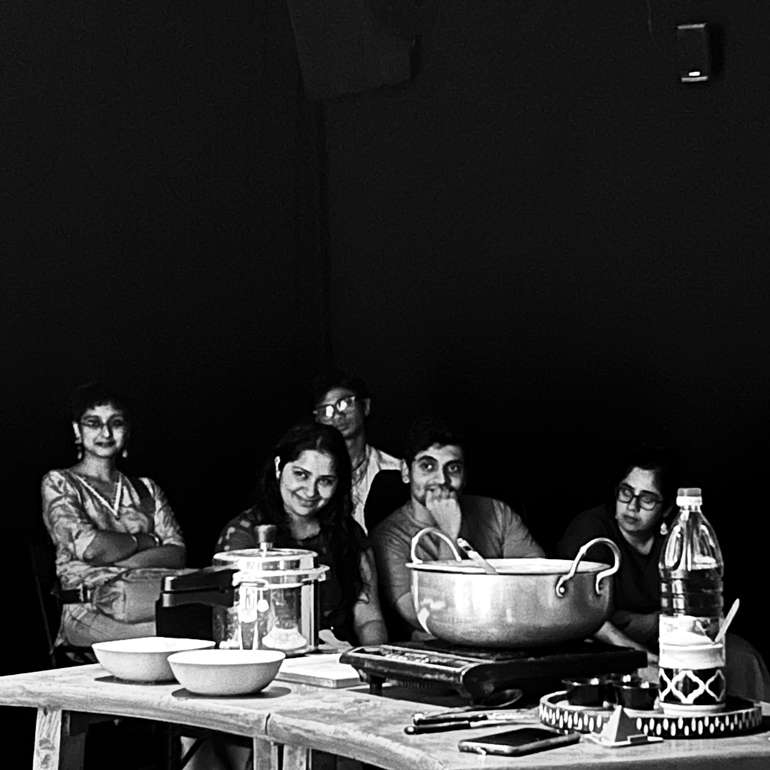
Of course, we also recognised the privilege of having a choice in the first place. Unlike the hungers we had inherited through stories of famine, Partition, or displacement, ours was a chosen hunger. But choice did not make it unreal. Somewhere in these conversations, I began to understand that food was also a way of reading theatre. It revealed its hierarchies, its economies, its care, and its contradictions.
A new play had begun.
As we came closer to staging the play, I was very nervous. I kept worrying that it was self-indulgent, even though my team, Dhanesh, Siddhesh, Utkarshh, and Sagar, had been constantly giving me feedback and pushing the play further.
We have now performed Kheyechish? in various places for people from different walks of life and different demographics. What has stayed with me is what happens after the performance. People stay back. They eat. And then they tell us their hunger stories. Every performance leaves us with more stories than we arrived with. I keep wondering what I could do with them because they are incredible. But for now, this is where I am. We have created something that continues to create more stories.
When my parents watched the play, a gap between us quietly closed.
They started sending me videos of Nawazuddin Siddiqui talking about his years of struggle. I think they believe that if someone like him could crack the system, then maybe I could too, if I simply worked hard enough. My mother now cooks far more than I can possibly eat whenever I go home because, to her, a full stomach can solve almost everything. And every time I leave, they pack as much food as they can into every steel dabba in the house, with one condition: that I return every single one of them the next time I come home.
She still asks me thrice a day, “Kheyechish?”

“ক্ষুধার রাজ্যে পৃথিবী গদ্যময়, পূর্ণিমার চাঁদ যেন ঝলসানো রুটি।”
Written by bengali poet Sukanto Bhattacharya
Meaning : In the realm of hunger, the world becomes prose; the full moon looks like a scorched bread
“Hunger in different dimensions — a thought-provoking perspective.”
The first question that most mothers ask children , living away from home, is this one- Eaten?
The various replies- often edgy and irritated- tell their own stories!