
![Gundruk: Sikkim’s Culinary Inheritance<br>Volume 5 | Issue 9 [January 2026]](https://www.oneating.in/wp-content/uploads/2026/02/1000055152-1.jpg)
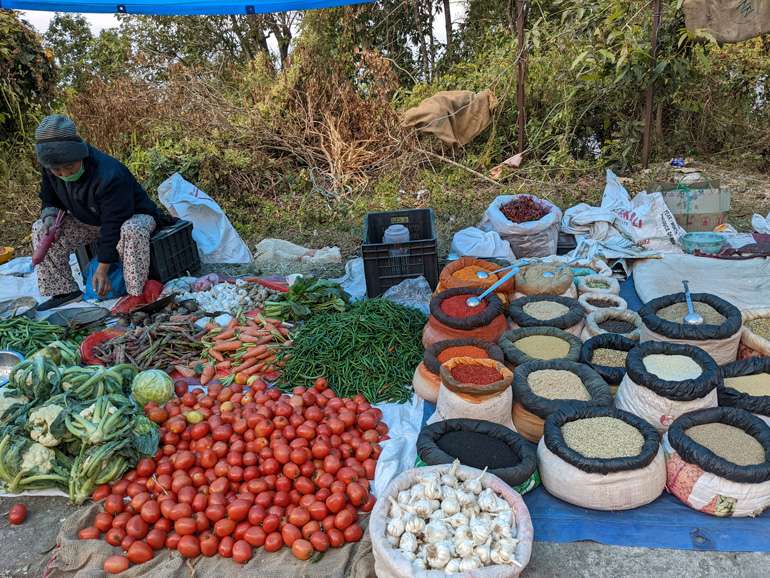
Winter is the time of abundant harvest in Sikkim. Rosy red radishes, pillowy cauliflowers, dewy looking cabbages, plump carrots beckon you at every vegetable stall. Most beloved of all are the leafy greens that are not just eaten fresh but preserved for the leaner months.
Walk through any settlement in Sikkim during this season and you’ll spot bamboo trays laid out in the sun, laden with cauliflower florets, radish batons, and carrot juliennes. These will soon be transformed into pickles or dried for storage. But among all these preserved vegetables, none is as ubiquitous or as culturally significant as gundruk.
Gundruk is a traditional fermented food made from leafy greens. It originates from the Himalayan belt, particularly Sikkim, Darjeeling, and Nepal, and is deeply tied to the food heritage of the Nepali-speaking communities of these regions. The word Gundruk is believed to come from Gunnu, meaning “dried colocasia stalk,” in the language of the Newar community of Nepal (Tamang, 2022). Its history goes back to ancient Nepal, when it was necessary to preserve leafy greens especially during the cold winter months (Panchal et al, 2024). The process of fermentation allowed the greens to retain their nutrients and prevent spoilage, while at the same time creating a desirable acidic taste (Rai et al., 2018).
Making gundruk is something I look forward to every winter. Each year, my mother carefully gathers and sorts radish, mustard, and cauliflower leaves, which are the main leafy greens used in this process. Using mustard leaves alone yields a milder, less acidic gundruk, and thus many people use a mixture of the leaves in different proportions to get the desired end product. Last winter, my mother and I made a batch of gundruk using a mixture of cauliflower leaves from the market and mustard greens from our kitchen garden. Since we used a higher proportion of the cauliflower leaves, the gundruk turned out to be on the sour side, which we prefer.
The leaves are first sorted, then washed thoroughly, removing any dirt or grit. They are then wilted, torn into pieces, and pounded in a pestle and mortar, after which they are tightly packed in an airtight container, which is then left in a warm location to undergo fermentation for around 7-14 days. Traditionally, it was buried in a pit and covered with jute sacks and dried leaves.
Towards the end of the fermentation process, the bright green leaves turn into a dull olive, and the container emits a mouth puckeringly sour aroma. At this stage, my mother usually does a taste test – if it is too sour, she gives it a quick rinse; if not, the leaves are fermented further for a day or two. When sufficiently sour, they are sun-dried on flat bamboo trays called nanglo, after which they are tightly packed and stored in a cool, dry place for future use.
Once dried, gundruk looks somewhat like a cross between black tea and dried black fungus mushrooms and has a rough, almost ropey texture. Its smell can be off-putting to the uninitiated – like damp hay or a farmyard – but is mouth-wateringly familiar to us Sikkimese who have grown up with it. Dried gundruk cannot be eaten raw; it is like chewing on straw (not a particularly pleasant experience, unless one is a cow!) and has no discernible taste, save a hit of sourness. The flavour and aroma of gundruk blooms when it is subjected to heat.
Gundruk is primarily prepared in two different ways – as achar and soup. Gundruk achar is a crispy, spicy and sour appetizer akin to a warm salad. The dried gundruk is roasted in a hot kadhai with some mustard oil until crispy. It is then mixed with chopped onions, roasted tomato puree, ginger, garlic, fresh green chillies and salt, tempered with some more mustard oil, and garnished with chopped coriander. My aunt makes a version of it with freshly fermented gundruk which is my personal favourite. It lacks the crispiness of the traditional achar, but the leaves retain a slight crunch that reminds me of kimchi. The sharp acidity and pungency of fresh gundruk, in my opinion, further enhance this dish. Sadly, I only get to eat it once a year as most of the gundruk is immediately dried for preservation. Perhaps its ephemeral nature makes it even more desirable!
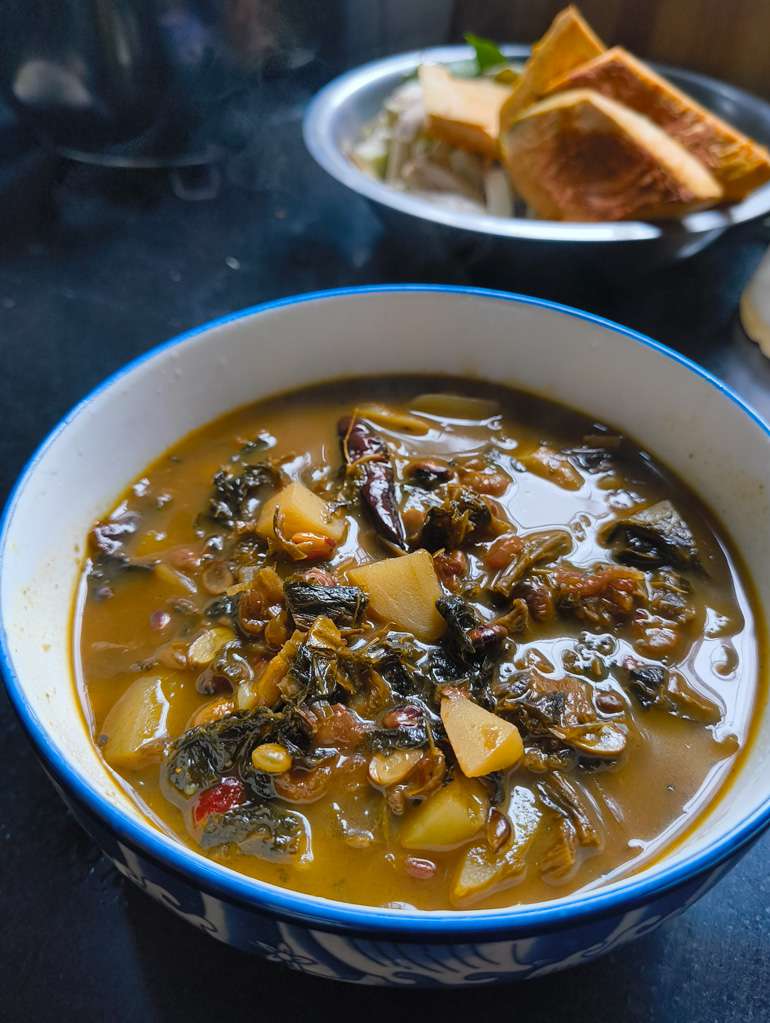
Gundruk soup, or gundruk ko jhol, as it is locally known, is likely the more popular version of the two. It is the epitome of comfort food, and can be served just as it is with some steamed rice, or with a side of sabzi and a generous dollop of tamatar ko achar. To prepare it, a handful of gundruk is first allowed to rehydrate in some hot water and is cooked in a pressure cooker, usually with some onions, potatoes, ginger, garlic, and the soaking liquid. The recipe does vary according to different households. For instance, my mother adds onions to her gundruk ko jhol but my aunt does not. Some people add roasted whole soybeans to the soup while others can do without it. However, everyone agrees that a bowl of piping hot gundruk ko jhol is just the cure for a runny nose or a bout of indigestion. Indeed, gundruk is a great source of vitamins and minerals, especially vitamin c, iron and calcium which are preserved during the fermentation process (Panchal et al, 2024). It also possesses anti-microbial properties and is a great probiotic (Tamang and Tamang, 2009).
Gundruk’s pungent aroma and fibrous texture can be polarising. Some compare its tanginess to that of the South Indian rasam, while others describe it as earthy and barn-like. The texture, especially when undercooked or improperly prepared, can feel chewy or rough. Yet, for many Sikkimese, it is precisely this sourness that makes it irresistible. Like many fermented foods around the world, such as blue cheese, natto, and kimchi, gundruk is not meant to be universally liked at first bite. It grows on you, and then it becomes a craving.
In a country like India where the mainstream food narrative is dominated by north and south Indian cuisines, fermented foods like gundruk are often described as “stinky” or “too strong.” This is a classic example of the phenomenon of “othering” of food, which is also sometimes accompanied by the devaluation of an ethnic identity (Wilczek-Watson, 2019; Poudyal & Rai, 2023). However, that may be changing. With the popularity of fermented food products on the rise, such as sourdough, kombucha, and kimchi, there is a newfound interest in foods that are “living.” Gundruk is made by the same lactic acid fermentation process as kimchi, where naturally occurring bacteria break down sugars into lactic acid, preserving the food while intensifying its flavour. Unlike kimchi though, gundruk is simpler and more rustic. There are no added ingredients – just leaves, microbes, and time. It tastes like the soil it came from, and the sun under which it was dried. Its flavours are not masked or complicated, and that, too, is its charm.

Dried gundruk is a staple item in the pantries of Sikkimese kitchens. Nowadays, it is easily available in local markets, especially in urban areas where people lack the time to make it by hand. I have personally delivered packets of gundruk to friends and relatives located in other parts of India who missed the taste of home. These days, a quick Google search is all it takes to find several e-commerce platforms selling gundruk in sleek vacuum sealed packaging. These packets are adorned with descriptors like “traditional,” “ethnic,” and “authentic,” which make one wonder whether these labels are required to increase the accessibility of a lesser-known product, or if they dilute its cultural identity. Both might be true. Either way, gundruk has earned its place in an ever-growing global pantry of fermented foods.
Despite being a popular ingredient in the Himalayan region, gundruk is served in restaurants primarily in just two ways – as a soup and an appetizer. Although one might see a handful of people on social media incorporating gundruk in tacos and dumplings, there is very little that has taken place in terms of experimentation in the culinary scene. This reminds me of a time up until the 90s when momo was a humble dish made and consumed together as a family, not the culinary phenomenon that it is today. With gundruk now being more accessible, and the rise in visibility of fermented ingredients, perhaps more people will be willing to push their tastebuds. It is only a matter of time before gundruk explodes in popularity, and expands the boundaries of Indian cuisine.
Gundruk is not just an ingredient but a culinary legacy, deeply rooted in the agrarian traditions of the Nepalese community that has been passed down across generations, space and time. My own family is a testament to this. Legend has it that when my ancestor Laksmidas Pradhan and his wife left Nepal to escape the infamous Kot massacre of 1846, they settled in Darjeeling and set up a small business selling gundruk. Every few days, Laksmidas would walk across the hill to Majhitar in South Sikkim where he would buy gundruk, and walk all the way back to Darjeeling to sell it. He went on to become a successful businessman, and was eventually invited to Sikkim by the erstwhile King to collect land revenues, where he eventually settled. The location where Laksmidas used to sell gundruk is known as “Gundri Bazar” to this day (Shrestha, 2005).
This story is just a small part of a much larger immigrant experience, back when Nepalese migration to Sikkim and the Darjeeling hills was at its height in the 19th century. For communities across the world, especially in a diasporic context, food is not just a means of nourishment, but provides a sense of belonging and is a significant marker of ethnic identity (Abbots, 2016). Gundruk, by its very nature, is a light, compact ingredient that is easy to carry, is packed with nutrients, and has a long shelf life. It is thus not hard to imagine why my ancestors, and that of so many others, might have travelled to Sikkim and Darjeeling with very few possessions and some gundruk to sustain them on their journey.
To me, gundruk is more than just an ingredient. It represents identity, resilience, and the collective memory of a community. It reminds us that food is not always about glamour. Sometimes it is about making do with what is available, preserving for hard times, and remembering where we come from. The story of my ancestor walking across hills to trade gundruk is not just a family lore, but a symbol of perseverance and adaptation in a foreign land. One may not be able to pinpoint exactly when gundruk was first introduced in Sikkim, but its ubiquity is a testament to its importance in Sikkimese cuisine.
Recipe for my aunt’s Gundruk ko Jhol:
Serves 4-6.
Ingredients:
- Gundruk – ⅓ cup, chopped
- Water (room temperature) – 2 cups
- Mustard oil – 2 tbsp
- Soybeans – 1 tbsp
- Fenugreek Seeds – ¼ tsp
- Dried Red Chillies – 2 nos.
- Potato – 1 small, peeled and cubed
- Turmeric powder – ⅓ tsp
- Salt – to taste
- Ginger Garlic Paste – 1 tsp
- Cumin Powder – ½ tsp
- Coriander Powder – ½ tsp
- Red Chilli Powder – ½ tsp
- Tomato – ½ small, finely chopped
Method:
- Soak the chopped gundruk in 1 cup of water.
- Rinse the soybeans. Heat 1 tbsp oil in a pressure cooker. Saute the soybeans for 2 minutes on medium flame.
- Add the soaked gundruk to the pressure cooker and preserve the liquid. Saute for 30 seconds and remove the gundruk and soybean mixture. Keep it aside.
- In the same pressure cooker, add the remaining oil. Add the fenugreek seeds and let it darken till it is almost black. Add the red chillies and let it turn into a light brown colour.
- Add the cubed potatoes, turmeric powder and salt. Saute for 2 minutes.
- Add ginger garlic paste, cumin, coriander and red chilli powder. Saute for 30 seconds.
- Add the chopped tomatoes. Saute for 3 minutes.
- Add the gundruk soybean mixture, the soaking liquid and the remaining water.
- Pressure cook for 10-15 whistles, or 7-8 minutes. Let the pressure release naturally.
Open the lid and adjust the seasoning and water content. Garnish with freshly chopped coriander. Serve with steamed rice.
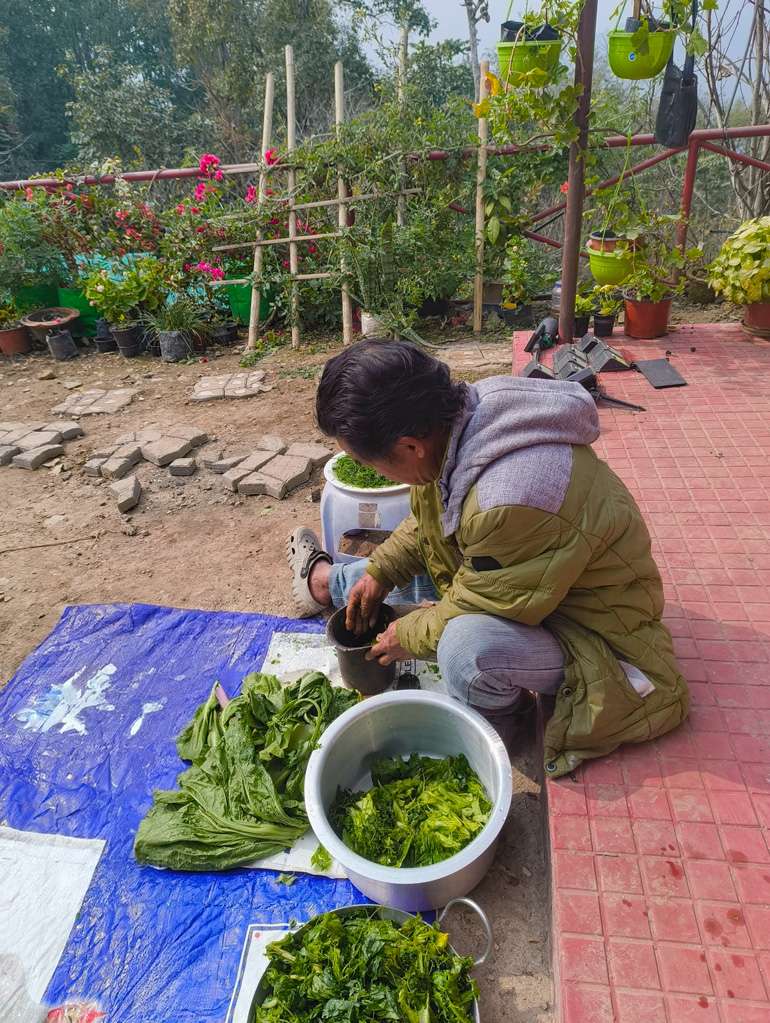
Pounding wilted greens in a mortar and pestle
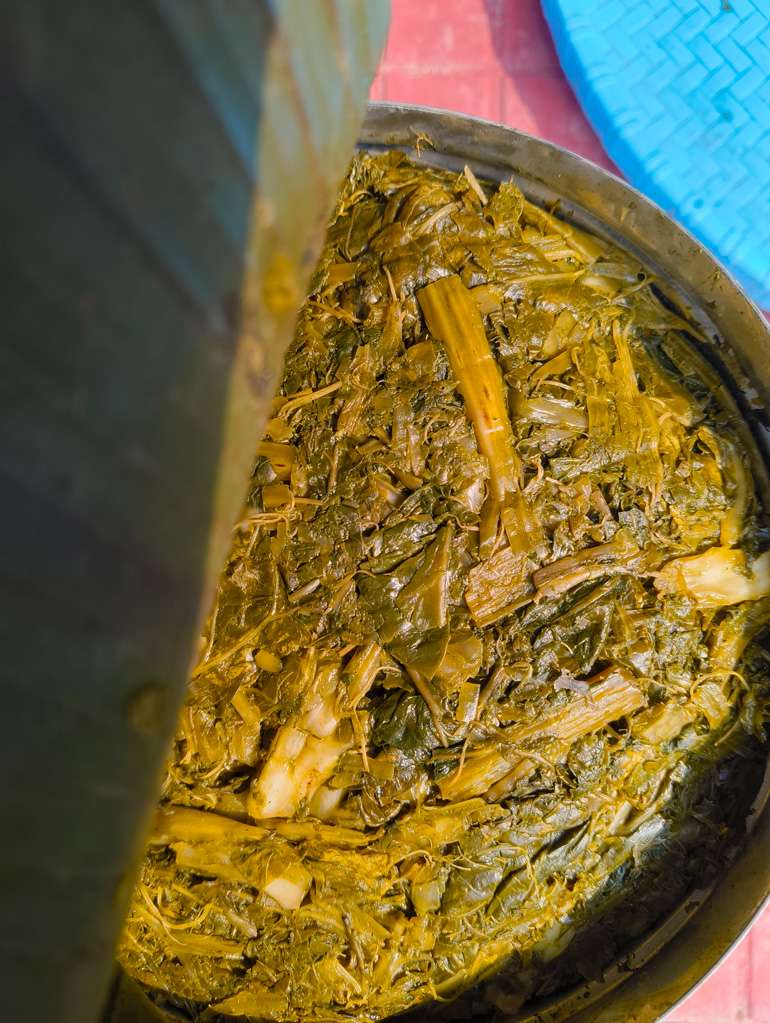
Freshly fermented gundruk
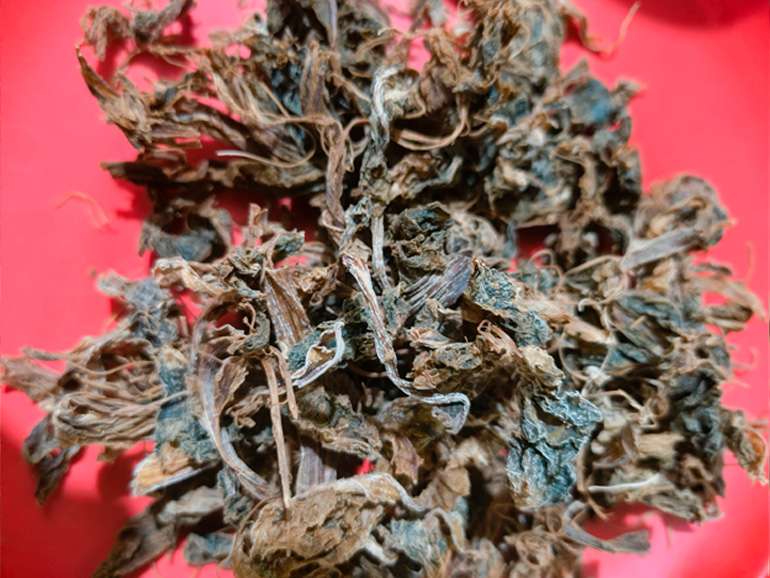
Dried gundruk
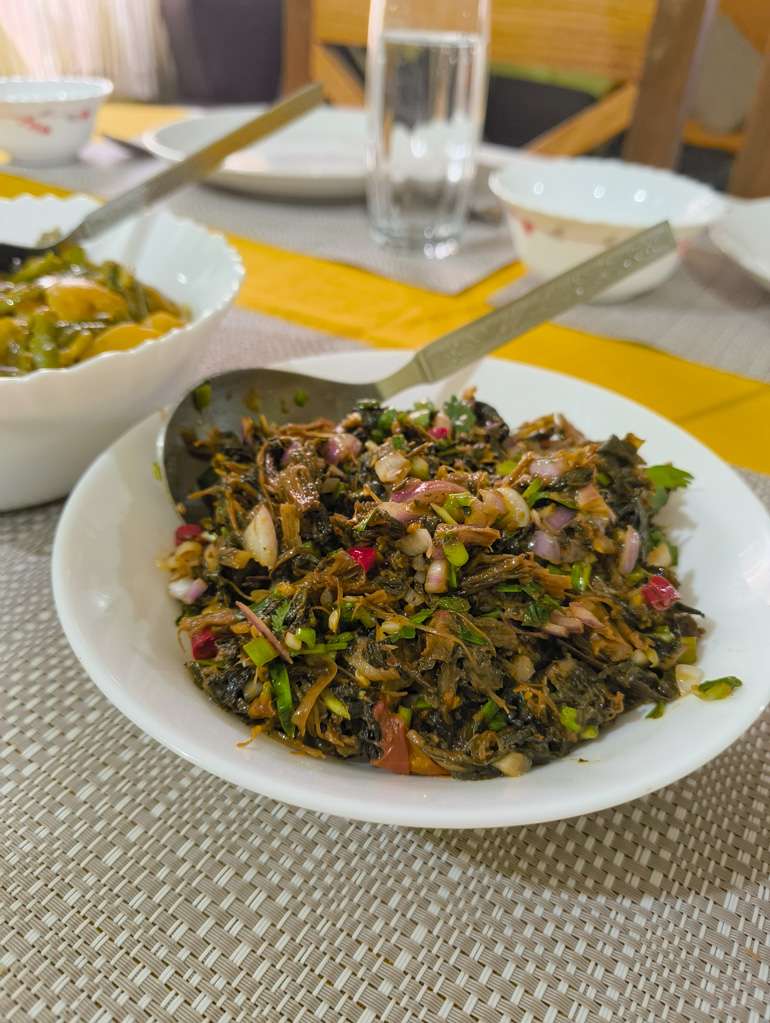
Gundruk ko achar
BIBLIOGRAPHY
Abbots, E.J. (2016). “Approaches to Food and Migration: Rootedness, Being and Belonging”. In J. Klein and J. Watson (eds.). The Handbook of Food and Anthropology. London: Bloomsbury. Pp: 115-132.
Panchal, P.M., Meher, S.K., and Gurumayum, S. 2024. “The Art of Gundruk: A Culinary Journey through Fermentation”. Agriculture and Food eNewsletter. 6(10). ISSN-2581-8317.
Poudyal, B. and M. Rai. (2023). “The Smell of the Other and Self-Alienation: A Mani(fold)festo of Race, Ethnicity, and Rhetorical (In)Accessibility to Food”. In E.E. Schell, P. Shrestha, and D. Winslow (eds.). Food Justice Activism and Pedagogies: Literacies and Rhetorics for Transforming Food Systems in Local and Transnational Contexts. London: Bloomsbury. Pp: 71-83.
Rai, P.L., Bhandari, S., Thapa, S., Sharma, B., Lamichhane, A., Chemjong, B., Rai, P. and Koirala, P. (2017/2018). “Preparation and Quality Evaluation of Compressed Gundruk Using Different Binding Agents”. Food Research Bulletin. Government of Nepal: Ministry of Agriculture and Livestock Development.
Shrestha, B.G. (2005). “Ritual and Identity in Diaspora: The Newars in Sikkim”. Bulletin of Tibetology. 41(1). Namgyal Institute of Tibetology, Gangtok.
Tamang, B. and Tamang, J. P. (2010). “In situ fermentation dynamics during production of gundruk and khalpi, ethnic fermented vegetable products of Himalayas”. Indian J. Microbiol. 50, 593-598. [doi:10.1007/s12088-010-0058].
Tamang, J.P. (2022). “Dietary culture and antiquity of the Himalayan fermented foods and alcoholic fermented beverages”. Journal of Ethnic Foods. 9(30).
Wilczek-Watson, M. (2019, 6 February) “Eating, Othering and Bonding”. Language on the Move. https://www.languageonthemove.com/eating-othering-and-bonding/

I rarely see such deep and meaningful writing in food like this. Kudos On Eating.