
Krishnamani would sit in the far-left corner of the covered porch of her modest one-room house, her gardening scythe resting beside her right thigh within reach. The curved iron blade and its wooden handle varnished by years of being held gave off a dull sheen in the light of the kerosene lamp. This was her spot in the house. After the day’s labors she would settle into her little seat on the floor fashioned out of a few old jute sacks folded into a neat rectangle covered by the tatters of what used to be a Calcutta cotton bed sheet. In the evenings she would settle into her little nook where the rounded corner of the wall would perfectly cradle her tired back. She would have just finished mixing the doughs for the snacks she would fry the next day at the crack of dawn.
They were all essentially the same dough. Each flavored a bit differently from the other. She would pound soaked rice and shelled black lentils in her giant mortar and divide them into three parts. For the plain murukku she would mix in cumin and white sesame, for the masala murukku she would add powdered red chillies, turmeric and asafetida, and for her famous thattai she would knead in a roughly ground paste of red chillies, cumin, garlic, shallots and curry leaves. She would wake up before sunrise and get the stove going. In the time that it took for the flame from the dried coconut husks to make its way up through the logs of wood she would have more than half of the snacks ready to fry. She would then put on the vat of oil to heat and finish twisting little ropes of dough into ringlets for the murukku and flattening small balls of dough into disks for the thattai. Once fried and packed, she would load them up onto the cycle drawn cart that belonged to her husband back when he used to climb coconut palms for a living. She would paddle up the lane, turn left and continue to the busstant where she had now become a fond fixture. She would get there a little before the school-rush began. Then came the office rush. After that the afternoon lull. She would mostly be sold out by then. She would hang around for a bit longer for the few housewives who would stop by her cart on their way home from the Paravathy temple in the heart of town. She would then start paddling back home, stopping by the vegetable vendors on the way. Their stocks too would have dwindled by then, and they would sell what remained to her for cheap. She would stop and chat with them for a bit, sharing a few nibbles of what remained in her cart.

When she was younger, she would make two trips. She would fry up more snacks after her lunch and paddle back up to the busstant in time for the evening rush. She had thought of outsourcing the evening operation to one of those kindly out of work young fellows who used to hang around the lane outside her house, but Krishnamani wasn’t the most trusting person. What if they swindled her or in their carelessness damaged her precious cart? Besides, one trip was enough for her now. The extra money would come in handy, but it’s not like she had to pay her children’s school fees any longer. They were all long grown and gone.
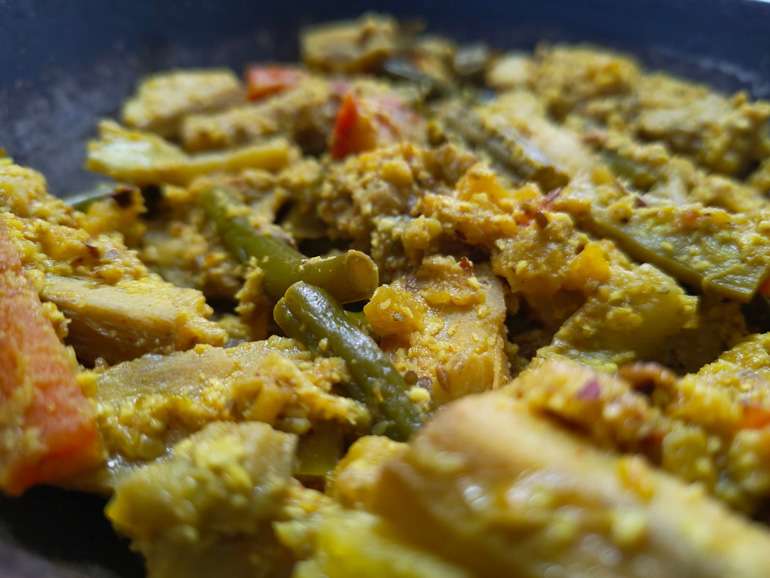
And so Krishnamani would paddle home with whatever produce she could find and cook herself some lunch. If the husband was around, she’d boil a little extra rice, otherwise she would cook just enough for herself. Sometimes on her way back from the busstant she was able to scrounge up all the ingredients to make her aviyal. This was a rare treat, because there is nothing she relished cooking and eating more than aviyal. In her own modest estimation, she cooked the best aviyal known to humankind! And that was because she was absolutely uncompromising about the ingredients she used and the rigors of its preparation. One could not just make an aviyal of anything one pleased. It had to be the right mix of hard and soft vegetables. It had to have drumsticks, elephant-foot yam, unripe plantain and small round brinjals. While a large brinjal may be more efficient, it lacked the necessary structural integrity. Also, the coconut used had to be on the more tender side. Use a coconut with thicker and harder flesh, and one would be left with an unpleasant oily and grainy after-feel in the mouth. She had learnt most of her recipes from her mother and her mother’s mother, but this aviyal recipe was an inheritance significantly worked on and improved by her over the years.
The husband liked it too. In fact, the only moments of civility that passed between them for many years now had involved food. The romance of conjugal life was short-lived for the both of them. Their first child came along. The disappointment of their first-born being a girl loomed in the air for a bit, and before it could dissipate along came another girl, a miscarriage, followed by another girl. This established a routine of the husband coming home drunk every night, and when he had the wherewithal to muster up the spite she would just lie back as he fucked all his frustrations into her in the hopes of making a boy. Another girl and three miscarriages later, Krishnamani gave birth to a son. There was a period of reprieve. No more fucking of any kind was necessary, hateful or otherwise, because the goal of birthing a son had been achieved. The husband also briefly sought to mend his ways and didn’t drink as frequently. He started to take a more active interest in the children, especially the newly born son, but the interest offset by his sobriety quickly led to the realisation that children are expensive. The husband’s primary work was that of a coconut picker. On the side he would gather the by-products of his trade, mainly coconut fiber and palm fronds, and sell them for a profit. However, after nearly a decade and a half since the nation’s independence, the promises of progress had been slaked by war, and folks like Krishnamani and the husband seemed to have been lost in the mix of a “mixed economy”. The communists in Kerala were of course sympathetic. However, their borrowed frames of reference could only accommodate the dignities of the industrial laborer and the farmer, and they were neither. Hence in these trying times, the husband could only pad the pockets of the local toddy shop proprietor with money that he didn’t have.
This would lead to the start of the rather curious routine of a nightly ritual performance. The husband would return drunk and start beating on Krishnamani demanding money to pay off his debt at the toddy shop. This was before she had started to make and sell her snacks. She had no money to give so she would take the beatings and had even let him pawn off some of the little gold she had. She would not give up her earrings though. The modest gold studs shaped like moringa flowers had belonged to her grandmother. When he tried to rip them from her ears, she fought back tooth and nail. When she drew blood from his forearms, he slapped her across the face and settled for the flimsy gold chain around her neck. All this changed when she started earning her own money. She didn’t have to take his beatings anymore. Having money for her meant that she now had something he wanted, and she was under no obligation to give it to him. She still remembers the night the ritual began. She had finished all her chores for the day and sat down with her garden scythe beside her in silent determination. When he returned from the toddy shop and came to beat up on her, she silently raised her hand in one swift motion and pressed the blunt end of the scythe to his neck and pushed him back. Taken aback for a moment he regained what composure his inebriation allowed him and tried to lunge at her again. Krishnamani swiped her scythe in his direction quietly and with purpose. He backed out of the way just in the nick of time. She swung again and again until without realising it she was chasing him around the front yard. He finally climbed the coconut palm in the corner of their yard to escape her and stayed there a while cussing her out at the top of his voice.
This would become their nightly ritual. Initially the children were concerned and the neighbors somewhat intrigued by this nightly spectacle, but like everything else its novelty too was devoured by habitualisation. One night many years after this ritual had been first instituted, long after the children were grown and gone, Krishnamani had just sat back down in her spot. She returned her faithful old scythe to its spot beside her as usual on the off chance that the husband found a second wind upon his descent from the coconut tree. She lit herself a bidi and took a few puffs. It had been raining incessantly since afternoon. She eventually started to nod off only to be woken up by the sound of a loud and dull thud. She didn’t pay it much heed thinking it must’ve been a jackfruit or a coconut falling from its tree. Then she heard the neighbor’s daughter screech. Krishnamani ambled out into the yard in the pouring rain and screamed out,
“What is it girl? What are you howling for?”
Krishnamani walked to the spot where she could make out the silhouette of the teenage girl in the dark. She asked the girl again what the matter was. The girl pointed to the ground below and spluttered the words:
“He’s dead… Uncle is dead.”
Krishnamani looked down and after a few moments of silence, the only words she could bring herself to utter were,
“Well, damn!”
The son now lived in Trivandrum and made it back in time to cremate his father. The eldest daughter arrived from Calcutta with her husband and two children the day before the thirteenth day’s funerary rites. The two younger daughters had been married off in the gelf. They would come later in the year. There weren’t too many mourners to feed, so all the cooking for the afternoon meal was done at home. The neighbor’s daughter came over to help out. Krishnamani insisted on having aviyal. She started by putting the hard vegetables—unripe plantains, elephant’s ear yam and drumsticks all cut into neat and tiny logs and some jackfruit seeds, into a boiling broth of salt, turmeric and curry leaves. As they cooked in a rolling boil, she ground the tender flesh of two whole coconuts with garlic, cumin and green chillies into a smooth paste. When the hard vegetables were about half-cooked, she tossed in the quartered small brinjals, some ash gourd that had also been cut into even logs, some sliced onions and stirred in some pulped tamarind. When all the vegetables were tender to the touch she mixed in the ground coconut. When the mixture started to bubble, she folded in a small pot full of curd and drizzled some coconut oil over it. She then put a lid on it before removing it from the fire and letting it sit for a while for the flavors to develop in the residual heat. All the while she could hear her son, her eldest daughter and her elder daughter’s husband talking in hushed whispers about what was to become of the house and her now.
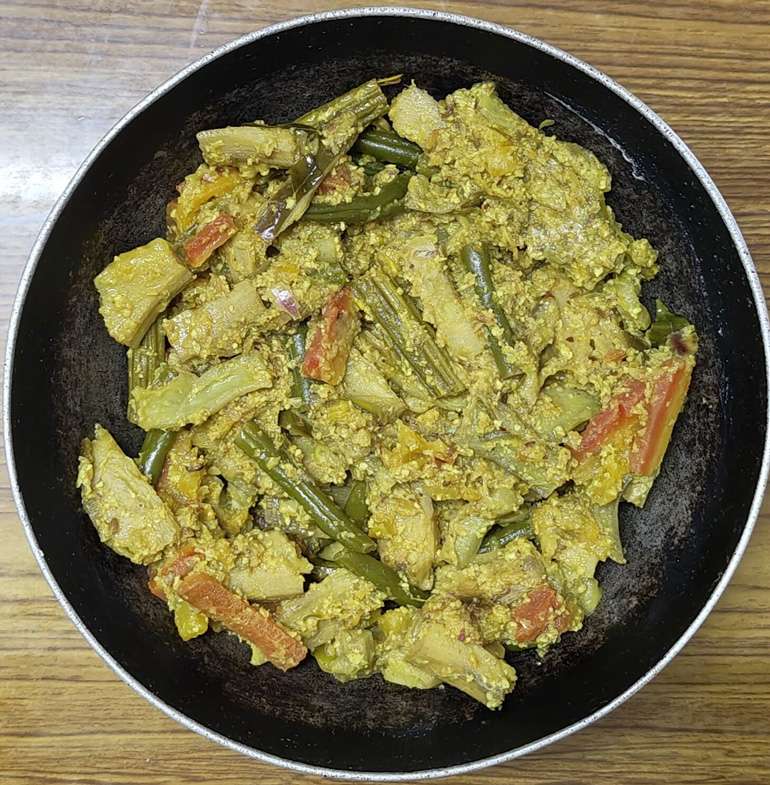
*Images – S. Satish Kumar

S.Satish Kumar,your story reads very easily and smoothly ,taking us not only into Krishnamani’s snack making kitchen routine but also into the heart of her strangely strong ,now single ,old woman’s everyday struggle .We admire how she changes the drunken husband’s ritual of entitled domestic abuse with a neat flex of mind and muscle.
And Avial !! the simple description so precise and neat , makes one want to make it like Krishnamani !
Really liked reading it 🙂 .
Brilliant,Satish!
Such a vivid portrayal of Krishnamani’s life! A beautifully nuanced story that displays the empowerment of a woman in a unique way. The flavours from the kitchen blend seamlessly into the weaving of a poignant tale. Loved it.Looking forward to some more stories from your end.
This story resonates deeply because it mirrors the lived experiences of many women. What I truly appreciated was how the protagonist was not portrayed as a helpless victim, but as someone who gradually found her voice, took a stand, and chose to take control of her own life. The strength in her choices felt empowering rather than dramatic. The writing is simple yet very articulate, with details that make every moment feel lived-in and authentic. It’s the kind of story that stays with you even after you finish reading. I genuinely loved reading this and admire how powerfully it was told.
Well damn ! That was a brilliant piece. I could visualise every bit of it ! The lady’s quiet strength is ever so remarkable – no whining or self pity. So much so that the discussion that the children have at the end sounds almost ridiculous – the lady is strong and self sufficient. Loved the description of the process in which the avial is made.