
![A Baker’s Search for Bread in India<br>Volume 5 | Issue 10 [February 2026]](https://www.oneating.in/wp-content/uploads/2026/03/Article-cover-Medium.jpg.pagespeed.ce.rLCP2J8ppg.jpg)
Today’s lunch was something I had been waiting for with unbridled excitement. It had been days since I’d tasted a delicious serving of my favourite Tambda Rassa; just one of those meals that instantly uplifts my mood. The most tender piece of slow-cooked mutton, coated in a symphony of spices and lifted by the kick the Maharashtrian Goda Masala is just *chef’s kiss*. It’s funny how truly deceptive words can be; how dare we call such a complex blend of craft and flavour a “staple” in my state. (A hasty flow of thoughts, I admit, as I opened my lunch box to inhale my first bite).
One of the beauties of every Indian cuisine is how complete every dish is; how every component, even the tiniest of mustard seeds, has a role to play. And although the star of the meal has always been the Rassa, I had rarely paused to acknowledge just how easily I took that piece of Jwarichi Bhakri for granted. The way the gentle sweetness lent by this tiny piece of bread, softens the fieriness of the spices and balances every bite with a certain quiet confidence, is truly one of those epiphanies you experience only when you pay close attention.
As I sat at my table, marveling at how the versatility of this bread is not limited just to the taste, but also the way the Bhakri has been shaped so perfectly that it naturally acts as a scoop for everything a cuisine has to offer, I saw loaves of freshly baked Sourdough, shiniest batches of Bagels, and a few beautifully braided Challah emerging out of ovens around me. It’s such a wonderful feeling to have a hearty meal around the aroma of fresh bread. But it just led me to wonder, however, how did a world of over 5000 breads even come into existence? How did bread evolve? Was it always supposed to be the way it is today?
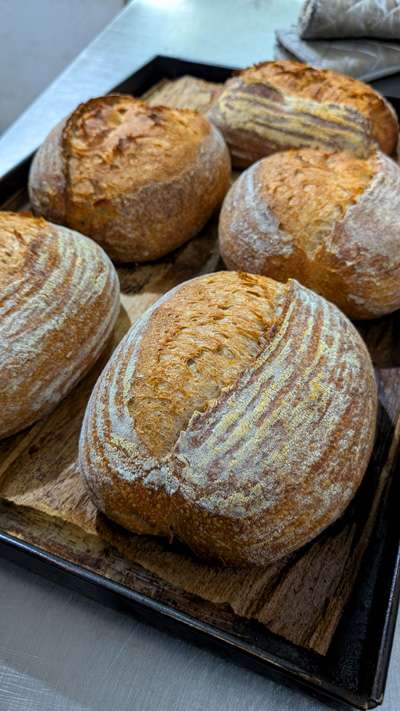
It is said that anything that combines flour, water, salt, and sometimes a rising agent can be referred to as ‘bread.’ But from the ancient Egyptian bakers who accidentally discovered the art of fermentation to the widely popular sandwich bread made possible today by the Industrial Revolution, the concept of bread has travelled a long way. The base remains the same, but the bread itself becomes a cultural representation of where it comes from. The way it has been shaped, the ingredients used to make it, the food it has traditionally been paired with, all tell stories of survival, community, geography, religion, and ritual. From baking flatbreads on hot river stones to uniformly shaped white rectangles baked in precise metal tins using electric ovens, we’ve indeed managed to make bread more sustainable, efficient, and convenient. And yet, it’s worth wondering: how did we take a craft that once took bakers years of diligent practice to master and turn it into a commodity wrapped in a plastic bag which you’d now get delivered with just a tap on your phone?
India, of course, has always had bread. Everything from the softest Idli to the Gujarati Dhokla, from the Amritsari Kulcha to the Goan Pao, is bread. Yet for decades, we have been taught to perceive bread as a western invention. A product rejected for years because of its wide association with colonial influence on Indian cuisine, bread even formed a basis of unfortunate religious prejudices in the early 1960s. But the convenience of sliced bread ultimately proved irresistible to a rapidly modernising nation. It became a household staple, as ordinary as rice or tea.
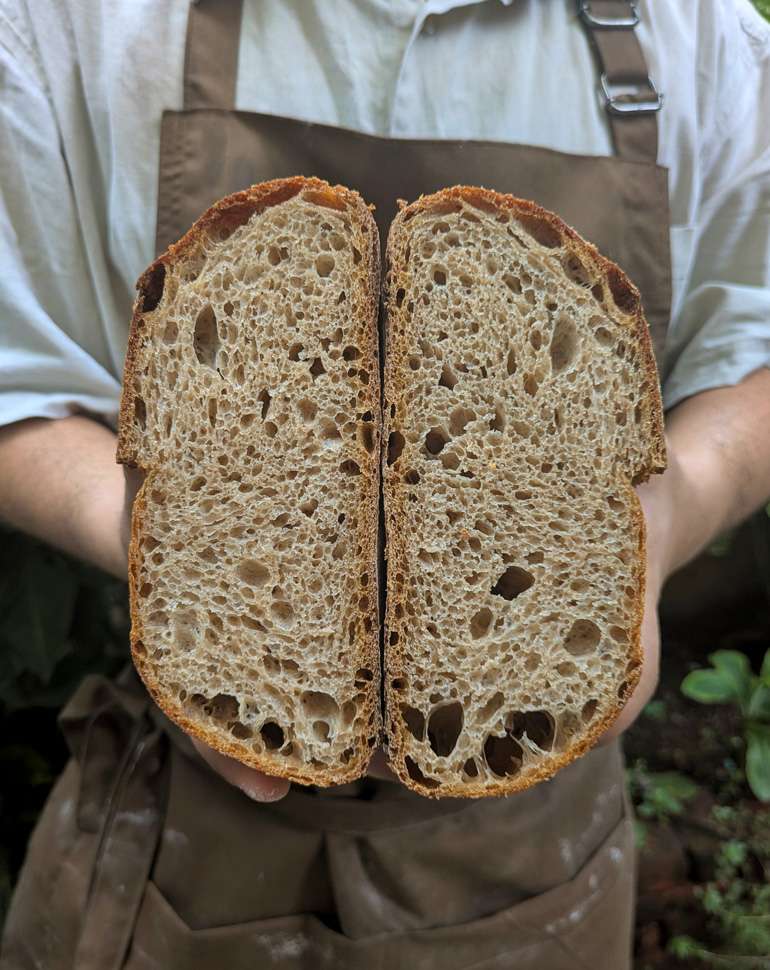
It’s fascinating how it all started with mothers toasting it, spicing it, even dipping it in egg to make it “Indian.” What was once seen as foreign or a blasphemy, eventually made its way to every school box, every common man’s breakfast by the street. From being a symbol of modernity and a colonial leftover, to being an inseparable part of our lives, right from our favourites like Pav Bhaji and Vada Pav, to some of the more modern adaptations like Sourdough Sandwiches, bread surely has come a long, winding way.
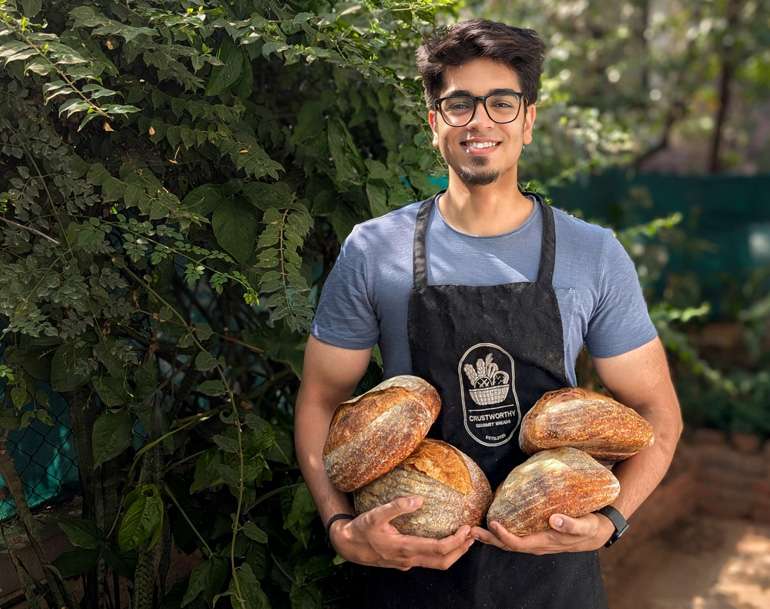
It was this fascination with bread and its versatility that made me venture into baking. As a biomedical engineer working to make medical devices affordable and accessible, my leap of faith into baking was least expected. What started as a simple lockdown baking experiment in a home microwave oven, evolved into a venture that truly changed the way the city of Pune perceived bread. Rather than it being a weakness, being an engineer and having this relentless urge to chase the depths of the science behind fermentation is what, I believe, has actually set me apart.
With the revival of tourism after the pandemic, and with people making their way back to India after having lived abroad, many have actually gotten a chance to try the immense variety of bread from around the world, with some having even made it a part of their daily meals. But finding a trusted source for these breads back home remained a challenge for most, which ultimately formed the foundation of my venture, CrustWorthy.
Of course, shifting my focus from biomedical engineering to a field I had never even thought of before was easier romanticised than done. It was actually during the lockdown that I first stepped out to buy what they said was “Yeast.” Channelling my newfound inner Gordon Ramsay on a bright, random Sunday morning, I decided to make Challah, a bread of Jewish Ashkenazi origin, something I had come across on YouTube (#JustLockdownThings).
But what followed was me trying to find my way through concepts and terminologies I had never even dreamt of. The science, however, felt very familiar and relatable. I baked the bread in a home microwave oven, nothing fancy, and it somehow turned out decent and edible, which, trust me, is quite an achievement when you’re baking for the first time. I still remember my folks actually posing and clicking pictures with the bread, their eyes filled with pride at what their kid had achieved while just messing around in the kitchen. But that first success, no matter how tiny, gives you all the motivation you need to keep trying, and that’s what I did.
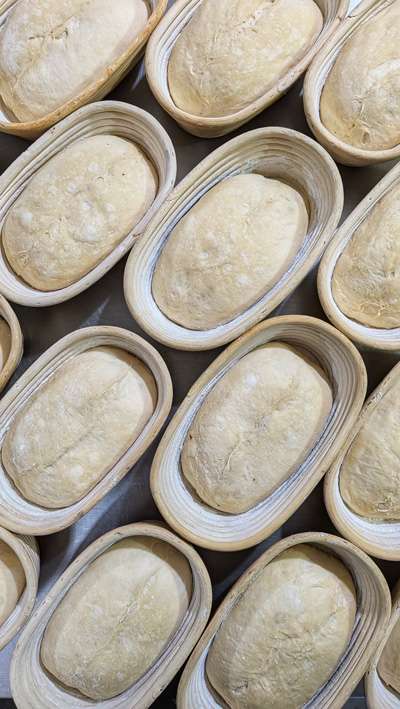
There’s a phrase from the Hebrew language that one of my favourite bakers, Roy Shvartzapel, often uses. It means: “One who doesn’t know how to dance says the floor is crooked.” Oftentimes, we tend to blame something else for our failures when we’re just starting out, rather than accept that we might not be very good at it just yet. When I got my first sourdough decently right, I had already failed 14 times before reaching that point. But those failures were all I needed to get a little bit better every time I tried. I was happy that I was making a new mistake every single time because it was an opportunity to learn more. I truly believe it’s a gift to not be good at something, because every day you get to wake up and realise there’s something new to learn. And I hope more people begin to think of life as a gift, to keep working on.
The plan has always been to make CrustWorthy about everything bread, diving deep into the intricacies of what sets a good loaf apart, ensuring the highest quality of even the most basic ingredients, and making bread approachable for those who haven’t explored the global variety as yet. Turning customer feedback into useful insights is one of the qualities that makes a good entrepreneur, but there is this one incident I remember particularly, as it actually altered the way I perceived this venture entirely. A customer once complained to us about a slice of Sourdough not tasting right. After a bit of discussion, it turned out, the gentleman had tried dipping it in a cup of chai and having it as is. The most Indian thing to do, and it just came naturally to him. Funny, yes, but for me, a brilliant case study of the market we were trying to serve.
I realized that adapting bread, which is traditionally perceived as a product of the West, to the Indian diet is the real challenge. I feel that India lacks what, in very simple terms, I would call ‘Bread Literacy’ and that’s what we’ve been trying to change, starting with Pune. The aim is to offer the best, simplest ways to consume bread (as basic as having it with butter) and to spread awareness about good bread, not just in Pune, but beyond. One step at a time.
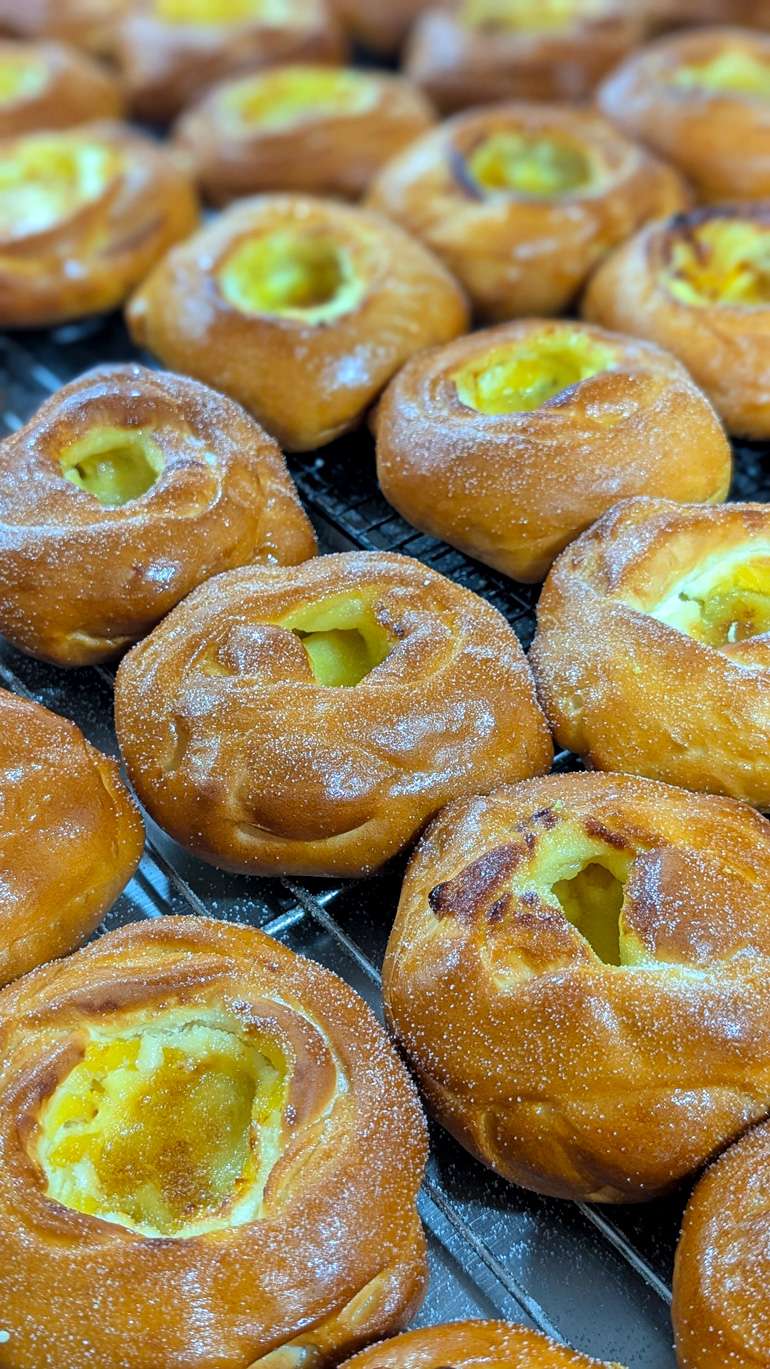
But in this quest to change our perception of bread in India, with each passing decade, our own breads have slowly stopped being seen as artisanal. Somewhere along this road of changing habits, are we losing our bhakri? Our definitions shifting, our attention changing. India’s real breads, the ones made by hand, governed by local grains, millets, geography, and culture, have continued to exist quietly in the background, unnoticed.
The story of bread in India is not one of invention, or trends, or western influence. It is a story of remembering what we always had but lost the vocabulary for. It’s funny how, when we choose convenience over craft, we often choose anonymity over identity. The breads of India were always meant to be intimate, shaped by the rain, the soil, the communities that sowed and harvested, and the craftsmen who milled, kneaded, and baked to feed their families. A certain kind of intelligence and intimacy like this just cannot be industrialised. It needs to be honoured and deserves all the attention and love.
Maybe that is where we lost our way? Not when the industrial revolution gave us packaged bread, or when modernity altered our breakfast tables, but when we stopped listening to what our own breads were trying to tell us. How the Bhakri cracks if the flour isn’t stone ground, how the Kulcha needs just the right amount of fermentation, how the Appam relies on a slight sourness to bloom; our food has always spoken to us in a lot of different ways. These are our techniques, our generational learnings, our temperaments, and our memories disguised as our daily bread.
To bring these breads back is not an act of nostalgia, but clarity. It is a decision to give back to our cuisine the respect it always had and to remind ourselves that this does not dilute, but redefines our identity. A nation that can hold both Pao and Paratha, Sheermal and Sourdough, Brun and Brioche, is how we know traditions and technology were never enemies for us. And perhaps that is where I found my answer to why I bake today. It is not to create or introduce a European ideal, or to romanticise the past, but to quietly pay attention in a way that our food needs us to. Bread is not foreign to us, the forgetting was.
So, the question is no longer if India shall accept artisanal bread. The question is whether we are ready to remember our own. Because somewhere between the Tawa, the Tandoor, and the Clay Pot, India has always known bread. And maybe that’s our truest return: not to new bread, but to the craft we forgot to honour.
Photos – Jay Panchpor

Wonderful journey you’ve embarked on Jay. Do you remember when we met and the time I visited your Bakery, Yes, during the Pandemic?
Nice article. Wishing you great success in this field
How wonderfully expressed and written. Maybe you could consider writing next!