
Last year, before Diwali, weaving through the bustling lanes of Mumbai’s historic Crawford Market, rubbing elbows with fellow shoppers, passing stalls of imported chocolates and other daily stuff, I came across the fruit and vegetable section. An oversized citrus caught my eye, which, according to the shopkeeper, was a pomelo and, for my husband, was gagar nimbu — essential for Chhath Puja.
I had eaten it as a salad in Chandigarh at my neighbour’s home who called it chakotra. Pomelo (Citrus grandis), addressed as Gagar Nimbu, Chakotra, Batabi Lebu, or Papanas, once commonly available and used as salad, pickles, and chutneys, is disappearing. Today, it is increasingly absent from everyday markets, edged out by persimmon, dragon fruit, and avocado that signal aspiration and novelty. Its survival, however, does not depend on commerce alone.
What markets discard, rituals often preserve.
In Eastern India, Chhath Puja keeps pomelo—and many other seasonal foods—alive through ritual. With no priests, no temples, and no sacred texts, Chhath functions as an ecological memory. While for most of India, Diwali marks the height of festivities, in Bihar, Eastern Uttar Pradesh, and Nepal, Chhath preparations are the highlight of autumn. There are no priests, no sacred texts, and no temples; here, sacrality resides in the devotee who pays obeisance to the agricultural fecundity and the power of the sun. As someone whose forebearers came from Western Uttar Pradesh, it took years for the festival’s austerity to resonate with me. Eventually, through marriage into a Bihari family, and the years spent in Patna and Santhal Pargana, I came to appreciate the rustic simplicity of every offering.
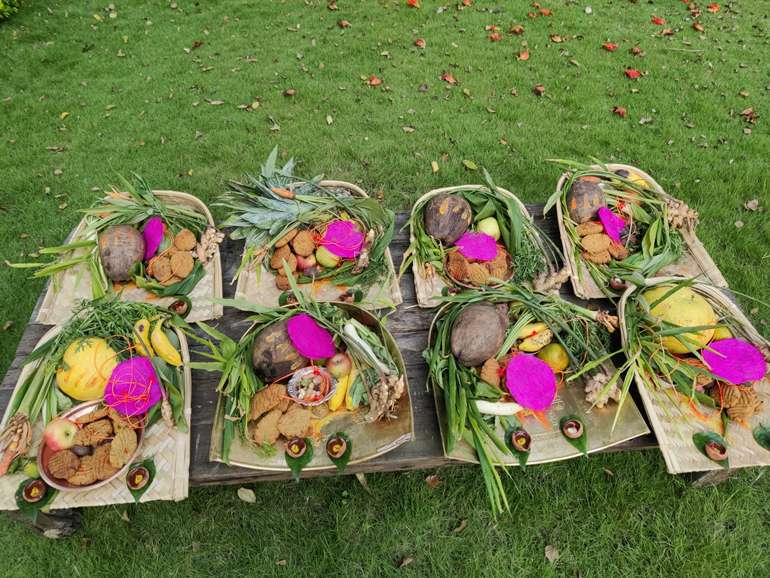
Thekua, that much-revered sweet smeared with a dash of tangy mango pickle, was my first introduction to the culture of Bihar. It is made from coarse wheat flour, ghee, and gur, with a hint of cardamom and slivers of dry coconut. I remember using a stone aata chakki for the first time to grind washed, sun-dried wheat for the thekua while listening to the Chhath geet begun by elders in their grainy timbre. As others join in, the words spill into the rhythm of work, fusing labour with the sacred. Especially noticeable throughout the festival is the emphasis placed on purity. Chathi Maiya, while benevolent in granting wishes to worshippers, can be enraged when neglected.
Among all the offerings in the supa (a bamboo winnow), the thekua is the only prasad that is kneaded and fried. Its demand is immense—both at the ghat and at home, and even for friends and acquaintances who could not make it to the puja. It requires a communal effort to make such an enormous quantity, made only after bathing and on an empty stomach. Today, carved wooden molds make imprinting easy, but earlier, the soft dough was pressed against the rough weave of baskets.
According to the Hindu calendar, the festival of Chhaṭh falls twice a year: Chaitra Chhaṭh, in the chaitra month, and Kārtika Chhaṭh, celebrated on the sixth day after Deepavali. The festival is also called Dālā Chaṭha because the supa or dala is offered during the evening and the morning arghya. Like every religious fast, the Chhath begins with nhaye-khaye on the fourth day, when the vrati (the person who keeps the fast) can take food only after bathing in the water from a well or a river. The food is sattvic: chana dal with arwa rice and lauki, or bottle gourd. You can also use kaddu, or pumpkin. Sattvic food ensures that the body is pure before seeking the divine to fulfill wishes.
In a traditional setting, food is cooked on an earthen stove. Those who lack access to courtyards and wood, use a stovetop. After the vrati, or fasting individuals, have eaten, they leave some of it for others, who partake in the leftovers as Prasad — extending the blessing and exalting the status of the vrati.
The day before the Sūrya Ṣaṣṭhī Pūjā, also called Kharna, is when rice kheer sweetened with gur or jaggery is made. After fasting, kheer prasad is served at night with rotis or puris made of either rice flour or wheat as prasad. This is after offerings that include kheer, milk, banana, radish, betel leaf, and betel nut are placed on a banana leaf and offered to the Chhathi Mata. The day also marks the beginning of the 36-hour-long fast.
The following day, the thekua is prepared in huge quantities; a collective effort, where those assisting in its making must also fast. Some family members go to the market to shop for the items to be placed on the winnowing husk.
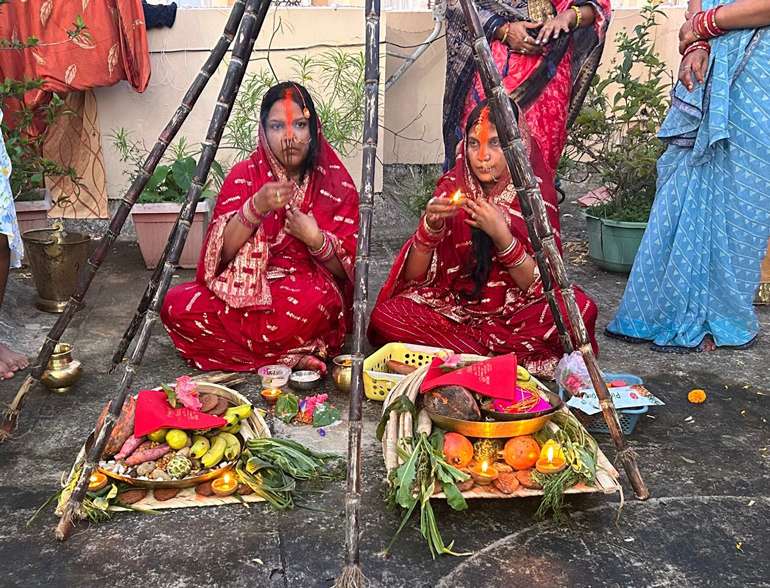
At sunset, devotees stand waist-deep in water, holding the filled supa (winnowing tray) toward the setting sun. The use of five sugarcane stalks along rivers and ponds demarcates the sacred geography. The lighted lamps, representing the sun, are placed inside this temporary altar. According to Tracy Pintcham, the sugarcane stalks used in this vrat, for example, represent the new harvest and embody themes of fecundity and the renewal of the earth’s fertility.
It is a symbolic union of sunlight and water that ensures abundance for everyone.
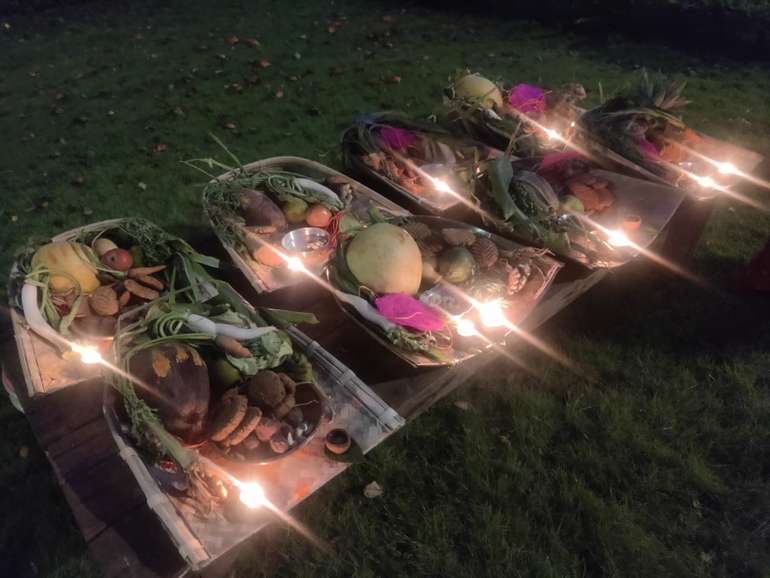
The fast ends the next morning (bihaniya argya) when the vratis offer water and milk and freshly filled supa to the rising sun. Others offer water to the chhahti maiya and ask blessings from the sun god. There is a general rush for the prasad that has been blessed and sanctified by the rigorous fasting journey of the vratis and by the rays of the sun. Interestingly, in the Mithila region, a similar offering is made to the moon during Chowtchanda Pūjā, acknowledging lunar rhythms alongside solar ones.
The devotion surrounding this fast in eastern India runs so deep that even those outside the practising community believe the sun’s blessings fall equally on all—irrespective of religion, class, or caste. Sanjeeda, originally from Madhubani and now settled in Delhi, continues to observe Chhath every year with unbroken faith. In Patna, Seema and her mother, living on modest means, have kept the fast for decades. Around them, the entire community comes alive in participation: basket weavers, kumhars (potters) moulding the chulha and diya, vegetable vendors, and countless others contribute their labour and offerings. With no formal scriptures or temple rituals to anchor it, Chhathi Maiya belongs to what anthropologists call the “little tradition” — a living faith sustained through collective practice, memory, devotion.
The primacy of sunlight to all forms of earthly abundance is sung in the Chhath geets, as they appeal to the Sun God and Chhathi Maiya. The songs, though tied strongly to the festival, imply the immense role of women’s labour in the agricultural tasks and their part in maintaining the security of agrarian households. My first memory of hearing them is from Daltonganj, in Jharkhand’s Palamu district, soon after my marriage.
“Get up, everyone will soon be coming to our house to sing the Chhath geet,” my mother-in-law called out. Wrapping my saree tightly around my shoulder, I joined the women — cousins, aunts, and neighbours — their voices rising and falling like waves. Among the words that floated toward me were Dinanath, Chhath Maiya, Daura, and Suga. In those songs, the sun peeped behind coconut palms; parrots lusted after ripened banana clusters; women named markets from where fruits could be bought; and wishes were uttered — for sons, for a beloved daughter and overall abundance for the family.
Years later, standing on my apartment balcony in Patna during Chhath, I would hear the words sung by iconic singers like Sharda Sinha and other rising stars in Bhojpuri music, broadcast from loudspeakers. Yet the words remain unaltered across generations. The city is drenched in a quiet, collective fervour.
One of the Chhath Puja geet (songs) runs as follows:
Saton kothaliya ji Deenanath
Saton me kebar Tohra
doobate ho deenanath duniya anhar
Tohra ugate ji deenanath duniya injor…
There are seven rooms and seven doors on each.
On your fall, o Sun God, the whole world becomes dark
On your rise, o Sun God, the whole world is full of light song
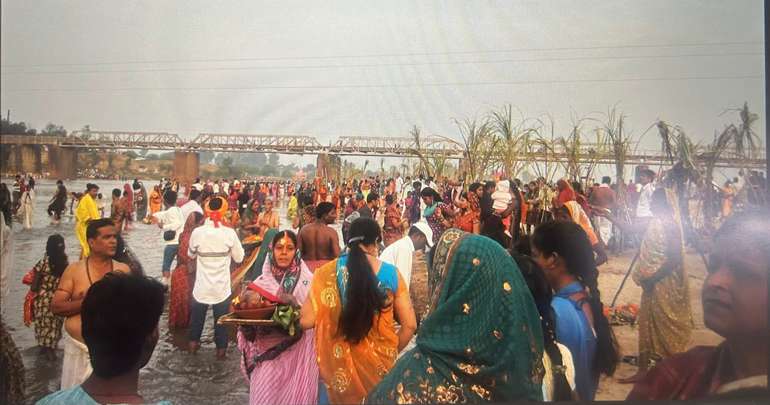
The verse reduces the ecological logic of Chhath to its essence: without sunlight, there is no food and no social continuity. The ancestry of Chhath traces back to an animistic tradition, and there are resonances in the Mahabharat where Karna is described as offering arghya to the morning sun. Encoded in these songs and varied offerings are conservation practices and local livelihood sustenance. A 2016 study on tropical fruit diversity found that some fruits are maintained in home gardens solely for the Chhath Puja. According to the authors, the best example of this is pomelo which is grown by most of the families only for this festival and not for any other purpose. The festival contributes strongly to the conservation of pomelo biodiversity in Bihar. It also highlights how home gardens not only supplement the subsistence needs of the family but also the family income by safeguarding varieties of fruits that are in high demand during festivals, especially Chhath.
Another important energy-rich root crop, consumed by nearly 300 million people globally but available in the local haats in this brief window of Chhath, is suthani, a yam that resembles a hairy potato. It was once a part of the regular diet but has now fallen out of favour because of changing tastes. Mrs. Punam Sinha, who has been practicing Chhath for over 30 years, mentioned that only her mother-in-law would eat chutney of suthani, but the younger generation has no appetite for it.
Association with Chhath also sustains a market for the hyperlocal variety of rice, the gamhari rice grown in the Sitamarhi region. This religious practice is a major driving force behind its cultivation, as the grain fetches a high price—exceeding ₹900 per kg. It is a niche variety that is husked using a mortar and pestle to ensure ritual purity, and no preservatives are added, conserving its natural shelf life. Sitamarhi, with its floodplain wetland ecosystem, is a major supplier of singhara, a non-cereal food during rituals and fasts and a nonnegotiable part of the supa in the Chhath festival. Singhara is of the most productive aquaphytes because the roots add to the plant’s photosynthetic capacity. The festival creates the year’s brief but vital demand, encouraging them to maintain the delicate aquatic ecosystems that make singhara possible.
These practices have not only ensured the survival of many foods but also livelihoods. In Mithila, where the monsoon and overflowing rivers cause a flood like situation in many areas, the practice of planting vetiver on the ghats for the Chhath Puja has not only ecological implications but also economic ones. Women use vetiver to create Sikki art, which not only provides an outlet for their creative energy but also helps supplement their family income. Vetiver plantations by local farmers on the bunds of crop fields ensure protection against high floods.
The Dom community, otherwise on the fringes of the Hindu hierarchical order, find their traditional skills in weaving of supa, dauri for this festival in great demand. The bamboo, because of its rapid growth and resilience, holds a deep meaning and is part of all rituals among the Hindus. As an ecological resource, the growth, harvest, and use of bamboo are woven into the ecological wisdom embedded in Chhath practices. The supa is anointed with vermillion and prepared to hold fruits, grains, and flowers for offerings, and their significance is celebrated in a much-loved Chhath geet:
Bahangoi lachkat jai, aragh ke beriya ho Chhathi Maiya
Gagar nimbua sugandh bikherat ghate suhagan jaye
Suraj devta ke argh deb, god me jal bhari lay
Nadiya ke kinare gunje geet, bhakti ras barsai.
Supa dhowa ke taiyaar bhail,
Phal-phool sajawle angana.
Nadiya ke path par nikli baratin,
The primacy given to purity and water bodies for offering oblation to sun and Chhathi maiya leads to an annual cleaning of the water bodies. The cleaning, and maintenance of water bodies and other embankments are carried out for celebrations of the Puja, and contribute widely to biodiversity conservation by maintaining healthy ecosystems, especially in the wetlands (Kesari, 2009).
The following lines depict Chhathi Maiya speaking to her devotees, mentioning how spider webs (मकरी बसेरा) and grass (दुबिया) grow on the ghat and urging the devotees to clean the ghat for the festival.
Kopi kopi boleli chhathi maiya,
Suniye sevak log, mora ghate dubiya upaj gaile,
Makri basera lihele, makri basera lihele,
Ai haath jodi kahe le sevak,
Raur ghate dubiya chilai debo,
Makri ujadi debo…
However, the ecological systems that Chhath depends on are under pressure. Wetlands are shrinking, riverbanks are increasingly concretised, and home gardens are disappearing from both rural and urban landscapes. There is an imminent danger of Suthani being pushed out soon, since, amidst the plenty, these lacklustre, sometimes unpalatable, weird-looking yams have no patrons. Pomelo and singhara remain vulnerable as tastes change.
As climate stress and dietary homogenisation intensify, the festival raises an important question: what happens to such informal conservation systems when the landscapes that support them are no longer viable?
Endnotes
- Research on tropical fruit diversity in eastern India indicates that certain fruits, including pomelo (Citrus grandis), are conserved in home gardens primarily due to ritual requirements associated with Chhath Puja.
- Arnau, G., et al. (2010). Yams (Dioscorea spp.): A neglected crop with high nutritional and medicinal value.
- Nayaboga, G., et al. (2014). Dioscorea species as energy sources in tropical diets.
- Lev, E., & Shriver, A. (1998). Ethnobotanical perspectives on root and tuber crops.
- Kesari, K. (2009). Ritual ecology and water-body maintenance during Chhath Puja.
- Verma, A. B. (2019). Role of aquatic plants in the livelihood purposes in the wetlands of north Bihar. Journal of Medicinal Plants Studies, 7(1), 120–123.
- Jha, Vidyanath, A. B. Verma, Rajeev Kumar and Mani Shankar Jha. 2016. Chrysopogon zizanioides (L.) Roberty (Katara jhar) as a tool for rural development in the floodplains of Mithila, north Bihar. Journal of Traditional and Folk Practices, 4(2): 104–116.
- Singh, Harsha, and Aanchal Malhotra. “The Ridges of a Thekua Mould.” Museum of Material Memory, 2024.
https://museumofmaterialmemory.com/the-ridges-of-a-thekua-mould
